The gathering in January was billed as sitting in that awkward intersection of religion and politics, which people in secular society seem to get so bothered about, but which is bread and butter to people of faith.
There is always a sensitivity about mixing scripture and politics. So much so, that at this gathering our president of the day opted to read the second reading herself, saying that she would not expect others to read out loud ideas and thoughts that they might strongly disagree with, or at least, feel very uncomfortable with.
But that’s getting ahead of ourselves.
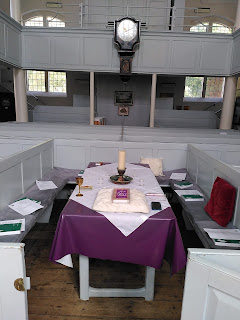
For the first-time reader of this blog, a bit of help so you can get the picture: our gatherings normally include elements of ritual, such as lighting candles, listening to recorded music, intervals of introspection and reflection on how we might be better people in future, some formally worded prayers, perhaps some poetry. Occasionally we hold a period of seven minutes of silence for private contemplation and meditation. There is usually the opportunity to sing along with recordings by the Unitarian Musical Society, who have kindly recorded many of our denomination’s favourite hymns. And there are usually two readings reflecting the classical Unitarian heritage — our prime library being the Bible and the focus of our inspiration being the famous Jewish leader and teacher, Jesus of Nazareth. Nonetheless, quite often we only hear one reading from the Bible (or scripture from another world faith) and then a second reading may be a counterpoint, a commentary, or a contemporary development of the same theme. It all depends on the choice by the president of the day, who then takes some minutes to explain why the readings have been chosen, and how they might bring additional meaning when set against each other.
On this occasion the first reading was familiar. It was the parable Jesus tells about a man beaten and robbed by thugs, the characters who subsequently walk past without helping, and who it is who finally stops to help and care for the victim. It is a story that is generally known by the title The Good Samaritan, and it can be found in the Bible, in the book of Luke, chapter 10 verses 25-37. Owing to its familiarity, the story is not now considered controversial, but it would have been shocking on a number of levels, when first told to its Jewish audience.
The second reading came from the blog of the Professor of Accounting Practice at Sheffield University, Richard Murphy. It was something Professor Murphy posted only a few weeks beforehand.
https://www.taxresearch.org.uk/Blog/2023/12/12/it-feels-like-some-people-are-driving-the-world-towards-insanity-and-no-one-is-sure-how-to-stop-them/
This blogpost is a cry of alarm by an academic, who reckons that people in world leadership positions are “threatening the stability of society as we have known it, quite consciously aware of the consequences, and apparently indifferent to them.” The pain and frustration felt by Professor Murphy in this post is almost palpable. He goes on, “I have often felt that we are close to a tipping point. Today, that feels closer than ever, and apart from drawing attention to the issue, I have little other clue what to do about it. It feels like some people are driving the world towards insanity, and no one is sure how to stop them.”
So how did our president knit these two readings together? It turns out she borrowed quite heavily from a book Freedom is Coming, by Nick Baines, Bishop of Leeds, as she put it together for us.
“Our first reading was the parable of the Good Samaritan. I last used that reading in April 2021, which is a long time ago. Too long ago. We should probably hear that reading every week, in some form or another. I’m not going to unpack it. I just leave it there for you to remember, and to think about. But I do follow it with this statement by Prof Dr Isolde Karle of Ruhr University in Germany:
‘It is completely imaginable that one day the story of the Good Samaritan will no longer be known or understood. Solidarity with the powerless, and deliberate care of the marginalized, of the sick, of people in need, are not self-evident.’”
That was actually a startling thought. And worse: as soon as we began to think about what it might mean — that it is possible that one day humans might not care about helping each other — we actually started fulfilling the thought, because we were making it imaginable.
While we explored the ramifications of that rather terrifying thought, our president went on:
“I have to admit that it’s not my mind that I first think of changing, to make this earth more like the kingdom of God. It’s the world I want to change.......... And yet, in the narrative of Mark about Jesus, the first words out of Jesus’ mouth tell us that he brings a philosophy of interior change: “Repent,” — change your mind — “for the kingdom of God has come near.” (Mark 1:15). Jesus begins his public ministry with this call: look differently at God, the world and yourselves, and refuse to be defined — or constrained — by your current circumstances or experience.”
Even though tradition has it that the gospel of Mark was written in Rome, Mark was writing for first century Jews. To a first century Jew, essentially ‘good news’ would mean the Romans leaving and the Jews getting their land, worship and identity back. So Jesus is daring first century Jewish people to consider the radical possibility that God can be here even while the Romans remain in charge of their immediate life and destiny.
Not being a first century Jew I was wondering where our president was going with this. She went on to suggest that the certainty that the power that creates order out of chaos whispers in us is that oppression, violence, despair, destruction, exile, and death do not and will not have the final word in this world. She said that God’s people, those who are drawn on by this hope, will always be outsiders and always look ridiculous to those who do not hear the whisper.
She argued that the way to avoid the loss of recognition and understanding of the tale of the Good Samaritan is to repeat the story and to keep talking about what it means. This story should be paid attention to, along with other stories that also have deep resonances. And to make that story real in our lives, we should keep paying attention to people and other sentient beings that are left by the wayside, even when other people pass by on the other side.
“Therefore, perhaps when we feel like changing the state of the world, when we feel like rising up to do something about it all, perhaps as Jesus says, it’s actually — after all — all about changing our minds — to repent — to live as if now is the time to do new things and live newly in the world — time to love God with all our heart, with all our soul, with all our strength, with all our mind; and time to love our neighbour as ourself. To live as if the kingdom of God has come near right now.”


