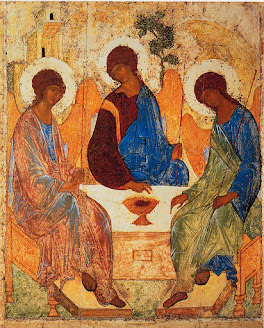
Showing posts with label Trinity. Show all posts

06 June 2024

The Trinity? In a #Unitarian gathering? Surely not – Unitarians in Ringwood gathering on 19 May 2024

Our gathering in the Meeting House on 19 May had both ritual and theological elements.


We do not encourage our service leaders (whom we refer to as 'presidents for the day') to spend a lot of time describing or defining theological ideas in our gatherings.  We rather like the quote attributed to the first English Queen Elizabeth, when she said that she “had no appetite for opening windows on men’s souls.”  She didn't want to know what each of her people believed; she wanted only that they could all worship together.


Generally, we prefer to spend our time together engaging in a practice; or at the very least, reflecting on a narratives from our common cultural religious background that inform our living.


But, despite our preference for practice rather than theory, the theory of religion cannot be altogether ignored, because people are often curious about what elements of faith go together to make up the Unitarian way of life; also, because we recognise that while practice is important, some of us remain thrilled by concepts and words and how they transform lives through the inner motifs they evoke.


A Bible lies open on a table.  Pairs of leaves of the book are rising as wings of birds, and are flying up and away.


The words that opened our gathering on 19th May represent the theological position that resonates with many of us, although we remember we can never be 100% sure.

“All that there is, is one, and that one is God.  It is as if all that there is, is one, and that one is God."

Then there was our normal practice element of reflecting on the past week, examining silently what we might do better another time.


Next there were two readings, looking forward a week to 26th May, which in other churches would be celebrated as Trinity Sunday.


The first reading was from Cyprian Smith.  It was an interpretation of the work of Meister Eckhart from the 13th/14th centuries.  Eckhart was a Roman Catholic priest, a mystic, who had had experiences of the divine that he tried to communicate to his contemporaries.  As with all mystics, he could only speak obliquely about what he had discovered on his spiritual journeying.  Naturally, Eckhart’s motif was the Holy Trinity of classical Christianity.  He wrote from his lived mystical experience about the relationships within the Trinity and the impact of the Trinity on human spirituality and relatedness to God.  Cyprian Smith is a current day Benedictine monk who attempts to clarify Eckhart’s rather difficult sermons and texts.  Despite Smith’s efforts, it was, nonetheless, rather mind-mangling.


The second reading was a description from a commentator on particle physics, Diarmuid O’Murchu.  The reading was about the discovery by physicists in the 1960s of what they identified as the ultimate building blocks of atoms: particles they named quarks.  And how since then, they have never managed to find a quark naturally existing in isolation.  Hadrons, which are the particles composed of quarks, have been artificially split using highly sophisticated technology.  But the quarks that came out of the splitting of the hadrons decayed in micro-instants. 

“The quarks were proving to be highly elusive, making sense only in groupings of two or three, displaying an elegant versatility to manifest their existence only in relationships. Quarks give up their family connections stubbornly, and then decay in a micro-instant, as if they have no way to survive out of relationship.  The capacity to relate seems to be at the heart of the quark world......... Across the sciences, there is mounting evidence for the fact that everything is created out of relatedness, sustained through relationships, and thrives on interdependence.”


Thankfully, with two such dense readings, there were plenty of musical interludes to allow us to muse on what we had heard.


a complicated pattern of coloured lines on a black background, generally in the form of interlocking circles and cross-overs


There were prayers, and a reflection by the president for the day on what the readings evoked in her.


This was wide ranging, and touched on references from other world faiths. She said, borrowing quite heavily again from Diarmuid O’Murchu, 


“The triune nature of God is something that is not unique to Christianity, but an archetypal phenomenon.  A way of dealing with the world, a key ingredient of universal life and culture.  It seems to me that the doctrine of the Trinity is an attempted expression that the essential nature of God is about relatedness and the capacity to relate....The real issue is not whether God is monotheistic or polytheistic.  What science – for so long the perceived enemy of religion – reveals and confirms is what many belief systems have been struggling to articulate: God is first and foremost a relatedness.”


And this was our closing blessing:


Let all we do be done in joy;

May we ever seek abundant living.

Let all we do be done in truth;

May we ever listen to the voice within.

Let all we do be done in love;

May affection for all that lives be the rule of our hearts.


04 June 2023

Long ago friend, long ago quote, fresh idea? Something from a Unitarian on Trinity Sunday

These words came from someone I once knew, who has long since moved away, as have I.  

On this day, which most churches label as 'Trinity Sunday', it might be quite reasonable to ask what the difference between and Unitarian and a Trinitarian is.  Actually, it might be less than you imagine, given that these words were written by a priest in the Church of England, and I as a Unitarian am happy to entertain them, in the light of the Hindu saying: "You think you understand two, because you understand one, and 'one and one make two'.  But first you must understand 'and.' "


We come to the Trinity.  God in three persons.  Trinity is logical non-sense.  How can one be three and vice versa?  But at the heart of Trinity is relationship and not logic.  God is relationship embodied.  How can “one” have a relationship with itself?  From a human point of view this would be extreme narcissism.  But how do you say being connected is at the heart of what it means to be?  Who each of us is, is only seen and known in relationship to someone or something else.  I am the son of Andrew, the brother of Tim, the person who ignored the beggar on 59th St etc.  Relationship is at the core of all existence.  Trinity is the expression of God beginning and continuing as relationship.  And ultimately, we know ourselves most fully when we see ourselves in relationship to Him who is Life itself.  Karl Rahner has described Creation as “God becoming present to himself.”  In a very real sense, all of us is God becoming present to each other as well.

Andrew Staley


07 August 2020

God the Intimate - Abba, Father - rich and contemplative provisos

(This is the fourth in our continuing series examining the wording of the traditionally Christian "Apostles' Creed" in a fresh way.)

Abba, Father

[God’s title of “Abba, Father” is only found referenced in the Bible three separate times, in the passages of Romans 8:15, Mark 14:36, and Galatians 4:6, which are all in the New Testament. Only two speakers utter these words in these passages: Jesus and the apostle Paul.  The word Abba is an Aramaic word that means “Father.”  It was a common term that expressed affection and confidence and trust. Abba signifies the close, intimate relationship of a father and his child, as well as the childlike trust that a young child puts in his “daddy.”]


I am going to use the words name and title interchangeably here. Though, be ready; I really want to be talking about title, even if I slip back into ideas around name.

I want to flag that fact, right up front and central; because whilst I always mean title, a way of saying something about ‘things’, a way of expressing a relationship of ‘things within a structure’, it is more common for us to talk in terms of name.  I am not looking to veer off into specialist language or make this jarring to read, but for the sake of honesty I want to be clear that this is what I mean.  Titles are bestowed from the outside; whereas the name is not just of them but from them.

A name, in the true sense, is personal.  A name is how we address someone we know.  If we’re lucky, the name by which we address someone also happens to be the name they know themselves by.  But this isn’t universally the case.  Does your cat really think his name is “Spike”?  Isn’t he, in his own understanding, “Cunning and Stealthy Hunter of the Night”?  A name is not as simple as what someone is called by, alerted by, invited by; it is how they understand themselves and it is how they give themselves to others.  Often the name we receive at our beginnings in our community  — as if it were indeed a title — is one we grow to fill.  For most of us it may become synonymous with the name in which we give ourselves to others; it may become integral to how we see ourselves.  But equally we can adapt it, even change it.  We tell others what our name is, no matter it may not originally have been our choice, no matter who may have given it to us first.  More seriously than “Spike” the cat, and perhaps of more relevance: is the name you gave to your son at birth the name she knows herself by (and has she yet told you her true name)?


Whereas, titles are about relationships: in fact, relationships are inherent to titles.  A community can teach us titles, because titles, like other jargon, are learnt by use within those communities.  We can all use the titles of our community, they belong to all of us, but the name is something given to us each personally.  “Please call me ‘Fred’,” is reserved for particular people within the community. 

However, even the titles we learn in our communities can become names — but they can only become names through a living relationship.  Then the name, unlike the title, is something we cannot share with others because it is not the sound of the word or the shape of the writing that creates the relationship, it is that living relationship that transforms that title into a name.  As an example: we call God by the title ‘Father’ in the Lord’s Prayer but it is the ‘Our Father’ of praying as a community.  For it to become ‘My Father’ — well, that is not something that can be taught or even tested from the outside: that is a matter of the lived relationship and personal experience in prayer.

There is possibly no better cipher or symbol for this than the traditional Christian ‘Holy Trinity’.  God is three and one, said to be truly one and also truly not only one.  If we are personally able to use this frame of reference, immediately we are faced with the real inability of even our most basic concepts — “one” and “many” — to be applied in an exhaustive or limiting way to that which we call God.  Moreover, we are not only faced by this reality: if this is our language, we face this reality without withdrawing from being able to speak about God at all.  We embrace being able to say something, while also embracing that there is always so much more than what we have said. 

But there’s more: in the Holy Trinity we also encounter God as relatedness (for more on this, explore the writings of Gregory of Nyssa), in which the titles ‘Father’, ‘Son’, and ‘Holy Spirit’ all refer back to each other, and are understood in view of each other.  This framework suggests that the ways of relating to God are many, not because they can be but because they have to be.  Each and every one does not stand alone but implies the others too.


This is not the place to develop a theology of the Holy Trinity, though there is a rich and beautiful tradition to draw on, which many Unitarians have neglected, that delivers a treasure trove of insights about relating to God, in the light of God’s self-relatedness.   Similarly, in the Hindu tradition, inherent to the universe is the relationship of Brahman the unmanifest potential of all that can be, sometimes known in the west as the Godhead, and Atman the manifest, the created, the ensouled God.  And in respect of this all-pervading relatedness, there is a wonderful Hindu saying: 

'You think that you understand TWO because you understand ONE, and ONE AND ONE MAKE TWO; but first you have to understand AND.'


For now I just want to make the point that in the same way ‘God’ as a no-name holds the place for that experience of the insistence on more , ‘Trinity’ holds the mind back from reductionist descriptions of the Divine and from mistaking any of God’s names as being exhaustive. 

The Apostolic Creed is in many ways an expansion of the idea of the Holy Trinity, not just in form (though there it is most clear), but also in reflecting on the meanings of each of the names of God given in that formulation.


How often do we get caught up in having to outline what we mean, and what we don’t mean, when we talk about or to God, in community?  We reach around, looking for shared experiences to draw on, and often find that for every good feeling invoked by a name there are profoundly negative experiences linked to it too.  We can find ourselves trying to use novel names or lengthy work-arounds which provoke responses we don’t intend — or which simply leave people cold.  Understood correctly, the moniker of Holy Trinity gets in there right from the start with the provisos, and moves our communitarian speaking of and to the Divine out of the realm of our many and varied personal associations with names; moves our speaking of and to the Divine into a place of a shared understanding of titles, and how they relate to each other and not just to us personally.

For some people, the experiences of their life may mean they never experience God in their lives as the ‘Abba, my Father’ of Jesus praying alone, but that doesn’t prevent them from honestly reciting the words ‘Our Father’ with the community.  Nor does it mean that they can’t experience the private intimacy in prayer that the words ‘Abba, my Father’ reveals. 


We fear that the way we talk to and of God in our communities will exclude and marginalise.  That concern is born of love, and of the awareness of how differently people can experience the world. Yet the truth that no name, taken alone, exhausts the Divine — and that how we learn in community to talk of and to God is the starting point not the end of our own lived relationship — can set us free from the knots we tie ourselves in.  To say ‘God is Father’ is to say something but not everything; it is to affirm something but not to exclude everything else; it is to indicate something but also to draw attention to there being more.  The Holy Trinity helps us keep our minds as open as we want our hearts to be, so that we can share in community not by ignoring diversity of experience but by embracing a shared context and a profound respect for God in the lives of each and every one of us. I believe in the Holy Trinity.


26 May 2019

May you live in interesting times - a #Unitarian lightbulb moment leads to a resolution to read The Arian Christian Bible

The topics of our gatherings in Ringwood range across a broad canvas of influences, as you would expect for a Unitarian group.  We have strengths in the areas of classical philosophy and living according to the Christian monastic traditions, both in community and in secular life; as well as an interest in natural religion, Buddhism, Earth Spirit and Pagan traditions, and Hinduism.  But funnily enough, we rarely talk very much about Jesus the rabbi and wisdom teacher.

Nonetheless, one of our number has volunteered the following little piece that broke in on her while she was attending and participating in a Church of England service for Palm Sunday.  It seems particularly relevant given the turbulent times we are currently living in, and the demands that are now surfacing for reform of the British political environment.  “May you live in interesting times,” goes the old Chinese saying, and it is meant as a curse!

~~~~~~~

“I am not a traditional, trinitarian Christian but I do find some meaning, in an unconventional way, in a Communion service.  So I participate in Church of England services in my own way, and if asked I am always honest and say I am there in an interfaith capacity.  Being asked why I am there, I have to say, is a very rare event.  Like most churches, I think they are glad to get the numbers up and they are also sensitive to the fact that no one expects to talk very much about their own personal faith after services.

“Many of the assumptions in the prayers and usually some of the sermonised explanations I have to set aside; but there is always something for me there, if nothing more than a safe space in which to worship God in my own way.

“At the Palm Sunday service I went to, the preacher developed some queries about the fig tree cursed by Jesus, and how it was that a colt could possibly have been made available for him without his disciples being involved. (Mark, Chapter 11).  At the point where the preacher started talking about the very stones crying out if the people were silenced, I was suddenly apart from the rest of the congregation as a thought broke in on me, like a lamp being switched on.  And it was this:

Jesus taught how to live compassionately and all inclusively, in the service of an intimate relationship with God, in a religious and political framework that was unjust and which needed reform.
And he was obedient to his way of life, no matter the shame threatened upon him, and the pain, torture and death done to him.

That seems highly relevant today.
And I would do well to think about Jesus more often.


"So I have come back from that service with the clear intent of making the next book I read The Arian Christian Bible published in 2010 by the Institute of Metaphysical Studies, USA. In the foreword to that book, Charles D Levy says: “It is the Arian contention that the only place the spirit of Jesus exists is in his words and in the hearts of people who read those words.”  

14 July 2015

July meeting

On Sunday 12 July the theme of the day was religious freedom.  Two hundred and two years ago, in July 1813, the Unitarian Relief Act was passed, which meant that it was no longer punishable to deny the Church's doctrine of the Holy Trinity.  This is an important commemoration for anyone who thinks that in the 21st century freedom of religion is as important as other human freedoms.

We listened to how Jesus had asserted that some of the religious rules of his day restricted people’s freedom – and hence he rejected them.  We heard about a chain of heroes throughout the ages who stood witness to freedom to religion by rejecting certain restrictions of their own day, and how they suffered for it.  Included were heroes local to Ringwood, such as Dame Alice Lisle, buried at Ellingham church.   And we heard how some Unitarians today feel that the word “tolerance” is outdated because it sounds grudging; and how they prefer the word “respect.”  Tolerance avoids engagement with others; respect welcomes it.

Included in our service were our usual ritual of sharing flame (light), bread, water, and smoke (air), all with due deference to participants’ respective needs; a couple of hymns from the green hymn book; and our seven minutes’ silence in which we had the chance to bring it all together.  Not that it was very silent with the busy footpath outside and the beautiful sounds of the bells ringing out from the parish church – and goodness knows how silent we were able to be within our own selves !

It was lovely to be able to welcome two new people to our service and we enjoyed our conversation afterwards.

22 June 2015

June meeting


Whereas in May our worship service had looked at “compassion”, and how that must translate into practical, outward action in the world, on 14 June our service focused on an interior aspect of a life of faith.

One of the defining features of Unitarian thought is its focus on the “one‑ness” of the divine.  This was one of the ideas that caused a schism between ministers of religion in the 18th century.  There were those who – in the best tradition of Protestantism – read the Bible for themselves, deeply and carefully, yet could not find any authentic reference from the earliest time to the Holy Trinity of God the Father, God the Son and God the Holy Spirit.  They saw all the teachings of ancient Judaism and the more recent teachings of Jesus as consistently pointing to a holy One.

In our service we started with a reading from Hinduism, which also points to the holy One.  Hinduism struggles with the different ways in which God is felt by people, and this results in Hindu people choosing – from among many faces or names for God – the aspect of God that resonates best for them.  But God is still seen as whole and one.  Hinduism contrasts with the faiths of classical Christianity, Judaism, Islam and even the Baha’is, in all of which God is seen as quite separate from creation.  But Hinduism is in tune with Paganism and the more liberal branches of Christianity – in these the one‑ness of God is seen as extending right into the created universe and into we ourselves as humans.  The word for this is panentheism  https://en.wikipedia.org/wiki/Panentheism .

We then silently shared a flame (light), bread, water, smoke (air), each placing our own private construction on the simple ritual.

Next we heard a reading from a Unitarian scholar and minister, Dr David Doel, who has written about what he sees as the nature of salvation.  He sees salvation (true peace) not as the reward for holding certain beliefs but as the fruit of an experience – the experiential recognition and acceptance of the love that lies at the heart of the universe and at the core of what it means to be human.

But this took us to the heart of our service.  The word “love” drives us to use the words “of”, “from”, “to”, “towards” or “between”; or else the name of what is loved.  The idea of love requires there to be two identities, with love as a draw or pull or flow between them.  So now we have ideas that apparently contradict.  The “one‑ness” of Unitarian panentheism and the “two‑ness” that the Unitarian experience of love points at.

We did not attempt to solve this problem.  But it was suggested that perhaps to make it possible to live with this contradiction would be to use the word “relatedness”.  Religion – a life of the spirit searching towards the divine that lies undiscoverable beyond existence – is perhaps about relatedness and mutual invitation.  And perhaps, at heart, this is what the idea of the Holy Trinity, with God playing as both parent and child and the flow between the two, was also trying to get at.

After hearing all this, we then used our customary seven‑minute silence as a time for our own private practice.  After candles of joy and concern we finished the service and made ourselves cups of tea.

During our service we had sung hymns about the different ways to view God (Hymns for Living no. 35) and how the church is a place of trust and searching (Hymns for Living no. 174).  We enjoyed the hymns tremendously; so much so, that after the service was over we carried on singing some more, using our hymn books and the recordings of the Unitarian Music Society.

30 May 2015

Three in One God as experienced universally?


The name "Unitarian" was first used as an insult but was gradually adopted and worn with pride. The insult was originally thrown at people who had read the Bible closely for themselves and couldn't find any reference in it to the Holy Trinity that had become (and remains) part of the doctrine of the traditional Christian Church. They were being insulted for using their own powers of intellect and analysis, and for coming up with an answer that accorded with their own consciences but which other people didn't understand or like. We can all understand that, can't we, because we are all wary of people who use different assumptions from our own.

So with tomorrow being celebrated by Christians in the west as Trinity Sunday, it is refreshing to find, on a website aiming for universal appeal, a new take on the Trinity, that might well be acceptable to people who now call themselves Unitarian:

".......creative Source that pours itself out in loving self-giving ('Father')... experience [of] ourselves ('Son') and all there is, as gift flowing from that Source ...... experience [of] life and love as a sacred mystery ('Spirit')...." 

 http://www.gratefulness.org/calendar/detail.cfm?id=50