Showing posts with label Hinduism. Show all posts

14 November 2023

Remembrance and Lamenting – online gathering for reverence November 2023

An eclectic selection of music was worked into the mix of this online gathering for reverence : a chant from the Taizé community, tracks from Johnny Cash and Billy Joel, a poem song from the musical Godspell and a hymn from one of the UK Unitarian hymnbooks, which together might appear to lend this service a cheerful sort of feel.  But actually this was a service about remembrance and lamenting, making reference to loss, anger and injustice along the way.


link to the Taizé chant, sung by the UUSM


The thrust of the gathering was about the repertoire of religious motifs we have, around which to organize our thoughts and emotions, our pain and our healing, when confronted with the griefs that have been around forever, and with the new catastrophes we are now newly beginning to suffer, as a result of our over-population and over-exploitation of the planet, and its peoples, over the last centuries.


Different religious motifs may be relevant to us at different phases of our lives, and in changing circumstances we may find those motifs changing.  


Our president for the day described how for many years Christianity had had little to say to her; but that was when she had perceived the world to be in stasis, with perhaps a general, gentle drift towards reduction in injustice and improved living conditions for all.  Having experienced a sudden change of perspective — which she described with reference to Adam and Eve eating the forbidden fruit of the Tree of Knowledge of Good and Evil, in the biblical creation story — she reported how her previously comfortable and even complacent life had been exchanged for interior discomfort with the occasional sleepless night.  And she sees no prospect of any return to the previous complacency : like Adam and Eve, she feels she has left paradise for ever.  And that has changed her interior landscape with regard to Christianity.


The themes of remembering the war dead associated with the Meeting House in Ringwood, which until 1976 housed a Unitarian congregation; prophetic rage at injustice and wrongdoing; and personal complicity in both evil in general and environmental destruction in particular, were all wrapped in to what was a highly personal view on how to cope when lamenting seems to be the only rational response.


"O Lord, how long shall I cry for help, and You will not listen?......Why do You make me see wrongdoing and make me look at trouble?  Destruction and violence are before me; strife and contention arise......In Your wrath may You also remember mercy." (from the Bible prophet, Habakkuk)


Specific motifs that seemed to help our speaker were that of Shiva the Destroyer of Worlds (Shiva Nataraja) from Hinduism, and the crucified Jesus from Christianity.  Reminding us that one does not have to have a top-down theory, or theology, in order to enter contemplation via a religious motif, or to experience the love of God first-hand, she said:


“Shiva the Destroyer of Worlds is a very handy motif when reconciling my panentheism with the scientific, astronomical perspective, though it can also help when my interior world is demolished.  

This Destroyer motif points at a dancing, humorous transformation — a transmogrification — rather than an annihilation....But one limitation is that this motif doesn’t show me in the picture.  It heals through its logic, but not through the deep emotion of belonging.  


It offers a logic but no hope.”


Our president for the day then apologized that she needed the words of someone else to present her own position regarding the crucified Jesus.  She then quoted at length from Richard Rohr, a Franciscan monk, in his book Things Hidden — Scripture as Spirituality. 


To help with this report, our speaker reviewed the quoted passage from Rohr, and has highlighted three points crucial to her, when she contemplates the crucified Jesus, and the healing this motif offers in those wee small hours of sleeplessness :


"Firstly, in the Cross, we can explicitly feel ourselves being pulled in two directions; towards God’s goodness, and towards our own complicity in evil. This could tear us apart, which is a common suffering in daily living.


Next, contemplating the Cross, we are immediately in a state of ‘not alone’-ness.  We do not get onto our cross by ourselves, and on our own we cannot pull ourselves in two directions.


Finally, hanging without resolution, in the paradox of goodness and evil, on our own cross — holding the contradictions, sharing and participating in the redemption of the world, forgiving reality for being what it is — is a way of gift : the gift that, at least in us, everything belongs."


07 August 2020

God the Intimate - Abba, Father - rich and contemplative provisos

(This is the fourth in our continuing series examining the wording of the traditionally Christian "Apostles' Creed" in a fresh way.)

Abba, Father

[God’s title of “Abba, Father” is only found referenced in the Bible three separate times, in the passages of Romans 8:15, Mark 14:36, and Galatians 4:6, which are all in the New Testament. Only two speakers utter these words in these passages: Jesus and the apostle Paul.  The word Abba is an Aramaic word that means “Father.”  It was a common term that expressed affection and confidence and trust. Abba signifies the close, intimate relationship of a father and his child, as well as the childlike trust that a young child puts in his “daddy.”]


I am going to use the words name and title interchangeably here. Though, be ready; I really want to be talking about title, even if I slip back into ideas around name.

I want to flag that fact, right up front and central; because whilst I always mean title, a way of saying something about ‘things’, a way of expressing a relationship of ‘things within a structure’, it is more common for us to talk in terms of name.  I am not looking to veer off into specialist language or make this jarring to read, but for the sake of honesty I want to be clear that this is what I mean.  Titles are bestowed from the outside; whereas the name is not just of them but from them.

A name, in the true sense, is personal.  A name is how we address someone we know.  If we’re lucky, the name by which we address someone also happens to be the name they know themselves by.  But this isn’t universally the case.  Does your cat really think his name is “Spike”?  Isn’t he, in his own understanding, “Cunning and Stealthy Hunter of the Night”?  A name is not as simple as what someone is called by, alerted by, invited by; it is how they understand themselves and it is how they give themselves to others.  Often the name we receive at our beginnings in our community  — as if it were indeed a title — is one we grow to fill.  For most of us it may become synonymous with the name in which we give ourselves to others; it may become integral to how we see ourselves.  But equally we can adapt it, even change it.  We tell others what our name is, no matter it may not originally have been our choice, no matter who may have given it to us first.  More seriously than “Spike” the cat, and perhaps of more relevance: is the name you gave to your son at birth the name she knows herself by (and has she yet told you her true name)?


Whereas, titles are about relationships: in fact, relationships are inherent to titles.  A community can teach us titles, because titles, like other jargon, are learnt by use within those communities.  We can all use the titles of our community, they belong to all of us, but the name is something given to us each personally.  “Please call me ‘Fred’,” is reserved for particular people within the community. 

However, even the titles we learn in our communities can become names — but they can only become names through a living relationship.  Then the name, unlike the title, is something we cannot share with others because it is not the sound of the word or the shape of the writing that creates the relationship, it is that living relationship that transforms that title into a name.  As an example: we call God by the title ‘Father’ in the Lord’s Prayer but it is the ‘Our Father’ of praying as a community.  For it to become ‘My Father’ — well, that is not something that can be taught or even tested from the outside: that is a matter of the lived relationship and personal experience in prayer.

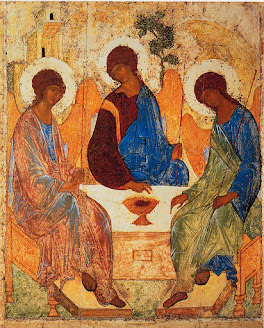
There is possibly no better cipher or symbol for this than the traditional Christian ‘Holy Trinity’.  God is three and one, said to be truly one and also truly not only one.  If we are personally able to use this frame of reference, immediately we are faced with the real inability of even our most basic concepts — “one” and “many” — to be applied in an exhaustive or limiting way to that which we call God.  Moreover, we are not only faced by this reality: if this is our language, we face this reality without withdrawing from being able to speak about God at all.  We embrace being able to say something, while also embracing that there is always so much more than what we have said. 

But there’s more: in the Holy Trinity we also encounter God as relatedness (for more on this, explore the writings of Gregory of Nyssa), in which the titles ‘Father’, ‘Son’, and ‘Holy Spirit’ all refer back to each other, and are understood in view of each other.  This framework suggests that the ways of relating to God are many, not because they can be but because they have to be.  Each and every one does not stand alone but implies the others too.


This is not the place to develop a theology of the Holy Trinity, though there is a rich and beautiful tradition to draw on, which many Unitarians have neglected, that delivers a treasure trove of insights about relating to God, in the light of God’s self-relatedness.   Similarly, in the Hindu tradition, inherent to the universe is the relationship of Brahman the unmanifest potential of all that can be, sometimes known in the west as the Godhead, and Atman the manifest, the created, the ensouled God.  And in respect of this all-pervading relatedness, there is a wonderful Hindu saying: 

'You think that you understand TWO because you understand ONE, and ONE AND ONE MAKE TWO; but first you have to understand AND.'


For now I just want to make the point that in the same way ‘God’ as a no-name holds the place for that experience of the insistence on more , ‘Trinity’ holds the mind back from reductionist descriptions of the Divine and from mistaking any of God’s names as being exhaustive. 

The Apostolic Creed is in many ways an expansion of the idea of the Holy Trinity, not just in form (though there it is most clear), but also in reflecting on the meanings of each of the names of God given in that formulation.


How often do we get caught up in having to outline what we mean, and what we don’t mean, when we talk about or to God, in community?  We reach around, looking for shared experiences to draw on, and often find that for every good feeling invoked by a name there are profoundly negative experiences linked to it too.  We can find ourselves trying to use novel names or lengthy work-arounds which provoke responses we don’t intend — or which simply leave people cold.  Understood correctly, the moniker of Holy Trinity gets in there right from the start with the provisos, and moves our communitarian speaking of and to the Divine out of the realm of our many and varied personal associations with names; moves our speaking of and to the Divine into a place of a shared understanding of titles, and how they relate to each other and not just to us personally.

For some people, the experiences of their life may mean they never experience God in their lives as the ‘Abba, my Father’ of Jesus praying alone, but that doesn’t prevent them from honestly reciting the words ‘Our Father’ with the community.  Nor does it mean that they can’t experience the private intimacy in prayer that the words ‘Abba, my Father’ reveals. 


We fear that the way we talk to and of God in our communities will exclude and marginalise.  That concern is born of love, and of the awareness of how differently people can experience the world. Yet the truth that no name, taken alone, exhausts the Divine — and that how we learn in community to talk of and to God is the starting point not the end of our own lived relationship — can set us free from the knots we tie ourselves in.  To say ‘God is Father’ is to say something but not everything; it is to affirm something but not to exclude everything else; it is to indicate something but also to draw attention to there being more.  The Holy Trinity helps us keep our minds as open as we want our hearts to be, so that we can share in community not by ignoring diversity of experience but by embracing a shared context and a profound respect for God in the lives of each and every one of us. I believe in the Holy Trinity.


12 April 2020

Easter Day 2020 – All shall be well

On the first day of the Jewish week after Passover, the first day it was permitted to move around after the festival, the women in the life of Yeshua went to retrieve and dress his body. 

But the body of Yeshua, the latest messenger of the justice and compassion of God, had gone missing. 


That sparked a whole new life for the story of Yeshua and — indisputably — launched and continues to launch new, clean, ‘begin again’ lives for countless millions ever since, to the present day. 

For myself, I find resonance with more oblique references to the mystery that is life; the notion of avatars (the material appearance or incarnation of a deity on earth) cannot engage me. 

A brilliant summing up was made by one of our group this past week: 

"I think there has always been a tension between the incarnate Word of social justice and lived truth, and the infinite well of being and possibility we live and move in.  I think doctrines like the Trinity are about bridging that experience without reducing one to the other or denying any part of it."

So, on the day celebrated by western Christianity as Easter Day, a model that means more to me, a model that makes me thrum like a plucked guitar string, is the model of the Hindu goddess Kali, wife of the god Shiva, and goddess of destruction and birth.  Known as the “dark mother”, Kali — a symbol only — symbolises the beginning and ending of being.  Sometimes depicted in her ferocious pose wearing a garland of skulls, she is said to devour karma — the endless ‘Groundhog Day’ cycle of death and rebirth conditioned by our careless, clumsy and stumbling actions — freeing us from its hold.


There is a beautiful devotional chant to Kali:

"Many names has our world Mother
Many dresses and many appearances.
I want to let you know my desire:
At the last moment of my life take me in your lap." 

And this chant, or prayer can be found here:


So on this day of new beginnings, what my Unitarianism tells me is that God has already encompassed or dealt with the dread consequences of our mis-steps; and Hinduism, Judaism and Christianity are merely three different ways of saying the same thing:  that in the end, “All shall be well, and all shall be well and all manner of thing shall be well.” Julian of Norwich

09 February 2020

Ringwood #Unitarians - Feb 2020 - Sixth anniversary service reflects on the weave of personal journeys into community with purpose

This was the gathering on the sixth anniversary of the founding of this group so we held the annual roll call.  The gathering wove together themes of community and personal journey, in which the readings were about communities, in various ways; with the reflections of the president for the day being about personal journey.
Opening
Some poetic words by Frank R. Clabburn opened the gathering and the first reading was a tale by Aesop as retold by Bill Darlison - reminding us that a bundle of sticks is stronger than individual sticks.  And by implication, people together are stronger than each of an isolated group of individuals.
We then carried out our little, silent ceremony, in which we share a candle flame, a piece of bread to eat, and water to drink, all in silence, without insisting on any specific meaning —except that the circle in which we sit is explicitly important to our gathering.


Naming, Knowing, Listening, Loving
We took a time of naming: being thankful today for the community that we have become over six years and how it has weathered so far; for the opportunities ahead, and how we can contribute; thankful also for being able to link across time with the Unitarians who had gathered in the Meeting House since the eighteenth century, and link across time with contemporary Unitarians and others who had provided some of the material we heard today.
The second reading was from Sailing the Worldly Winds by Vajragupta and it reported on some recent research that showed that — rather disappointingly — happiness seems to be determined by comparison against others.  A cautionary note about how we look at ourselves and others.

The third reading was from We Are One by Simenon Honoré and in it we heard a new word that had been coined by Milovan Djilas, a former leading Communist in Yugoslavia: Djilas suggested we need to think of humans as being not perfect or imperfect; but rather, as unperfect.
Djilas suggested that Utopianism insists on perfecting society, and can create a great deal of human suffering in an attempt to attain this impossible aim.  Better that we give ourselves permission to be unperfect, to make mistakes and to take responsibility for them.
Then we took some time for prayer and reflection.  In that time we aimed at some knowing: we each reflected on what a community of people — of spiritual explorers — is for; and how each of us as persons might fit within this community.  At this point the roll call was taken so that we know who is included in our community during the next twelve months.
As a segue to our meditation time, aimed at being a time for listeningwe heard some words by Tony McNeile.  After our silence we lit tea light candles as we spoke of our recent concerns and joys, after which we chanted to a music by David Kent: Do what most kindles love in you, representing our engagement with loving.

Reflections of the day
Our president for the day noted that culturally our society is still visibly rooted in Christianity, and that it may be all very well and good throwing out the big idea of Christianity — that God and human can be one, were in fact one, uniquely so, in Jesus — but then where and what is the new big idea to replace it with?

She suggested that Unitarians long ago threw out the last part, about the uniqueness of Jesus, but are still contemplating oneness.  Unitarians are about oneness; and many Unitarians would still be content to affirm that a person is a nexus between the concrete world and the eternal realm.

The president spoke of her own journey of “there and back again”: away from her childhood home of traditional Anglican Church doctrine and practice, into what for her was a long wilderness of happy, adventuring aloneness; and back again, but back to a new home; a home in the Unitarian movement.  Of how she had studied other wisdoms along the way, and found them very satisfying, especially some of the Hindu teachings.


All this is full.  All that is full.
From fullness, fullness comes.
When fullness is taken from fullness,
Fullness still remains.
Isha Upanishad

Our president quoted another regional Unitarian, who has recently said:

“For me there is the rigour of asking myself is what I’m saying true; true to shared experience, true to the constellation of other things I hold, true to the yearning of my heart?  I can talk in the language of different traditions but accept that there is a cultural and historical prominence of one in my life and in my part of the world.”


But the “there and back again” of her journey, said the president, meant that although she would not expect ever to belong to a Christian church again, she does go home to some ideas of Christianity, which means that she is able to visit Christian churches and worship there, and happily talk with Christians about faith and how to make it live.

Among the ideas that our president said she retains are these (with traditional Christian references indicated thus):


That there is at one and the same time both ‘oneness’ and ‘relatedness’ at the core of ‘all that is’ and in the ground of truth on which ‘all that is’ is constructed.
(The Holy Trinity)
That, in the round, everything is all alright — our mis-steps are catered for in the universe — and we are wanted in the universe or we wouldn’t be here.
(We are loved, and loved unconditionally, by God. God has dealt with the dread consequences of our sin.)
That all human persons are equally wanted and the mercy and justice of God works through the body of divine humanity — us — so we need to work for equality and justice.
(The mercy and justice of God works through the body of Christ.)
That the human person straddles the concrete world and the eternal realm, and the Christ archetype is the logos of the human person.
(Reserved in Christianity to Jesus the Christ, uniquely.)
That interior work is needed if justice and well-being is to be secured for all.
(Keep the Commandments and follow the teachings and example of Jesus; narrow is the way.)
That the most important interior work is to learn to love what irritates or persecutes us, as by doing this we can transform the barriers, isolation and stuckness of ‘twoness’ into the wholeness of ‘oneness’.
(Love your enemies and pray for those who persecute you.)
That there is always the possibility of change for the better, if only we take the first step and turn.
(The new covenant of repentance and forgiveness, fulfilled in Jesus the Christ.)
That at least one person — Jesus — has demonstrated that it is possible to be so trusting of life that it is possible to make, and gain fulfilment from, the ultimate sacrifice, without losing that trust in life.
(Jesus’ crucifixion)


Closing

After a chant from the Northern Cheyenne Nation, for pow-wows and inter-tribal dances of welcome, the gathering closed with the poem Desiderata by Max Ehrmann, and a hymn from the green hymn book.


10 September 2019

Different Religions, Different Approaches at our gathering in March 2019 - #Unitarians mustn't sideline studying different faiths - thinking as well as experiencing has its place

At our gathering on 10 March we held a service designed with children in mind, though the children’s story was - like the best stories - multi-layered, with several messages for adults to unpick during the week to come.

Our gathering picked up on an aspect of the life of communities of faith that seemed to have been missing from the recent Festival of Unitarians in the South East, which we had attended as a group.  That aspect was a journey into comparative religion, or comparison of different theological perspectives from different world faiths.


We started with a Pagan creed, written by one of our own number, then heard readings from the Baha’i and Hindu faiths. We considered several points.

The first point was the particular theological difference highlighted in the two readings, namely that the Baha’i faith considers God the Creator to be completely distinct and separate from the created universe, with the two not in any way to be equated.  By contrast, the Hindu faith sees the ultimate creating principle, Brahman, to exist as Atman inside all that is created; and that a person who realises the Atman within has also realised Brahman, so may in all seriousness declare, “I am God.”  This may chime with some of the sayings of Jesus and other mystics, whose words are recorded in such a way sometimes to be unclear as to who is speaking.

Shrine of Bahā'u'llāh, the prophet of the Baha'i faith, in Acre, Israel
We also heard that whereas Western Christianity as known during the late Middle Ages seemed to stand definitively with the Baha’is on this issue, St Francis of Assisi challenged this with his reverence for all things created; and his legacy has come through to the present day.  Franciscan teachers such as Richard Rohr and those likeminded in his community feel able to make statements such as this, in the present day (the link below the image is to the source website):


The second point considered was that when people of two theologies come into contact with each other, there are (at least) two possible reactions.  Religious people who are conservative in their approach may set up barriers in order not to dilute their message for the sake of certainty, and to keep their identity clear.  Religious people who are liberal (progressive) in their approach may seek to include both theologies in order to prevent boundaries being set up and to include more people.  We explored that as well as benefits, there are costs associated with each approach.  The actions of religious conservatives may instigate conflict.  The actions of religious liberals will require change within the group to accommodate new ideas, which is hard work, and can give rise to uncertainty regarding identity and who belongs.  We owe these ideas to Jonathan Haidt.  https://www.ted.com/talks/jonathan_haidt_on_the_moral_mind#t-185395

The third point we looked at is the idea that being conversant with a range of different world faith theologies and concepts makes one multi-lingual in terms of religion.  As with languages of the world: some things can be said in one language that simply cannot be said in another language.  People who can only speak one language find this hard to grasp, but bilingual families will recognise this very well.  For much more on this fascinating subject see David Bellos Is That A Fish In Your Ear? Translation and the meaning of everything https://www.bookdepository.com/Is-That-Fish-Your-Ear-Professor-French-Studies-David-Bellos/9780865478763?ref=grid-view&qid=1552404573799&sr=1-2
If we can speak the lingo of another faith then, even with people whose theologies we cannot share, we can have some extremely interesting and civilised conversations. And more personally, in having a variety of different ways of speaking about faith we have a richer vocabulary in which to speak about the religious experience.

Rev Bill Darlison (a Unitarian Minister) has also touched on the idea of one’s early received religion as one’s mother tongue, in his book of essays The Penultimate Truth and Other Incitements https://www.bookdepository.com/The-Penultimate-Truth-and-Other-Incitements-Bill-Darlison/9781846858062


Woven into all this thinking in our gathering, we also did some experiencing.  We experienced our usual silent ritual of making a circle with a candle, bread, water, and a fan of feathers.  We sang a couple of hymns from our green hymn books, held a seven minute silence for meditation or prayer as we each needed, and lit candles of joy and concern.