01 May 2021

How much do we think we are worth? Really? #Unitarians

Three related occurrences have happened to me in the past ten days.


Firstly, I was a bit piqued by something I read about a liberal stance towards society.  I read an item that said that a liberal focuses on individualism, freedom, justice and tolerance.  So far, so good.  But this is what was said about a liberal’s attitude towards justice: “A liberal says that people should get what they deserve.  Those who contribute a lot to society should get a lot back.  Nobody has to contribute, but those who don’t won’t get much back from society in return.”


I think of myself as a liberal person and something about this made me feel uncomfortable.


courtesy Redbubble
courtesy Redbubble


Secondly, using the Ringwood Unitarians' Twitter account, I came across a twitter thread:


Tweep 1: “Never ever let your dreams stop you from doing what you want. Show the world you can do things that people think are impossible! Disabled people can do anything if you put your mind to it!”


Tweep 2: “Sometimes. But quite a lot of us have conditions or disabilities that mean we can't fulfil those dreams. We aren't less for that. We aren't less for not being able to prove to people that disabled people can do things they thought they were impossible.  Our value is in who we are.”


Tweep 3: “Yup. Not in what you do.”


And thirdly, I took part in a discussion today in the context of the Southern Unitarian Association, in which we were deciding the amount of grant that should be extended in a certain case, by reference to precedent.  It was tempting to say a reduced amount should be given, owing to the differing circumstances.  But in the end, the question boiled down to whether one person was worth more grant today than had been another person a few years ago.


Put together, these three incidents put me in mind of the parable of the landowner of the vineyard, as told by Jesus of Galilee and reported in the book of Matthew, chapter 20 verses 1 to 16.  Jesus said that the kingdom of heaven — for which you may prefer to read ‘paradise’ — is like a landowner who one day hires people to work in his vineyard at various times.  At the end of the day, those who worked all day during the heat of the day expected to be paid more for their day than those who had stood in the market place, un-hired, during the heat of the day and who only worked an hour or two in the vineyard.  But the landowner paid them all the same, and challenged the grumblers, reminding them that they had got the agreed terms for their labour.


What are the agreed terms for our existence?  Is what we are due from life in any way at all contingent on what other people get from life?  Are we really to be measured against each other using some measure of worth?


~~~~~~~


Having dangled three occurrences before you, I will now satisfy your curiosity:


1.    I did some research and I found that the description of liberalism I had come across recently had been written in 2017 and had been completely re-written by its author in 2020.  The later version now expresses the characteristics of liberalism in terms of “freedom”, “freedom ‘from’” and “freedom ‘to’”.  https://www.simplepolitics.co.uk/explainers/liberalism/


2.   I was Tweep 3.


3.    The Southern Unitarian Association decided to grant the same amount in the immediate case as had been granted in the preceding case.


15 April 2021

Another creed

 It is often passed off as the case that the Unitarians have no creed.

As we have often remarked here, that is not the case.  Every Unitarian has a creed (in fact, we would argue that every person has a creed - a philosophy or set of values that they live by, whether they recognise them in that way, or not).

We have recently published here, in serial form, a take on the Apostles' Creed by one of our members.

This has set another one of our members thinking, about their own personal creed. And they are now happy to publish it here.  It's a photograph of the front page of their daily office (service) book and journal, ready and waiting to be seen and reiterated every morning, as a measuring stick for the previous day and a goal for the day to come.


14 April 2021

Life with the neighbours — giving, but with no sense of condescension

As Chesterton wrote : ‘We have to love our neighbour because he is there – a much more alarming reason for a much more serious operation.  He is the sample of humanity which is actually given us. Precisely because he may be anybody he is everybody. He is a symbol because he is an accident.’  G. K. Chesterton, 'Heresy' (House of Stratus, Thirsk, 2001)

~~~~~~~~~

For only the second time, people who usually meet under the Unitarian umbrella in Ringwood (Hants, UK) met on Zoom on 11 April 2021.


We lit the candle in our chalice at the start of the gathering.


In the gathering there were prayer and blessing words from Rev David Usher, Rev Andy Pakula, Darren Canning.  We heard a suggestion from Marcus J. Borg on a relevant way to read the Bible, 'Reading the Bible Again for the First Time — taking the Bible seriously but not literally.'  The website  www.bibleodyssey.org had also been a help in preparation for the gathering.  There was music from www.smallchurchmusic.com and the Unitarian Musical Society.  There were two readings, and we were also given the space for private, personal prayer or meditation practice in the customary seven minute period of silence.


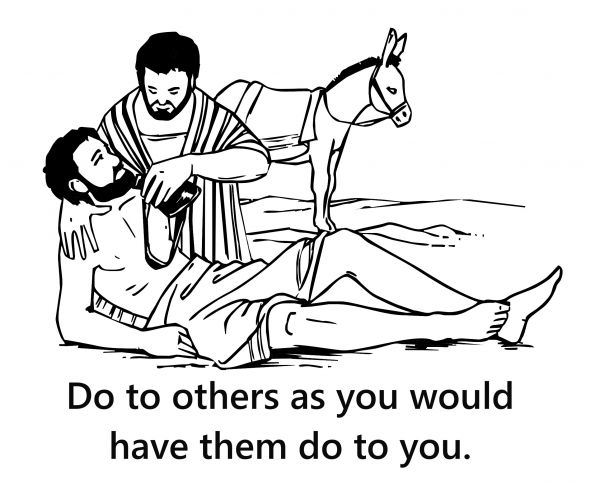
The first reading was from the Bible, taken from the book of Luke, chapter 10 verses 25-37, a story commonly referred to as 'The Good Samaritan', but which we now prefer to know as 'The priest, the Levite, and the Samaritan.'  The take home points were these:

  • Jesus presented the ethnic and religious outcast not only as the story’s hero but also as the moral exemplar and, because of the compassion he showed the person in need, the inheritor of eternal life — the one to imitate, should one be seeking to inherit eternal life.  The corollary implied by Jesus was that, on their showing that day, neither the ritually pure priest nor the Levite would inherit eternal life.
  • Jesus switched the question from, “Whom should I love?” which placed the recipient of the enquirer's love as an object to 'be done to', to “What must I do to show love — what am I prepared to risk to show love — what does it cost me to show love?”  In so doing, Jesus prompted the listeners to build in themselves the capacity for loving, independent of the identity of the recipient.  And to stop treating others as objects.
  • To label the Samaritan in the story “good” (a word never used in the text) is to participate in a racist assumption that being “good” is an unusual and noteworthy achievement for Samaritans.


The second reading was from 'Utopian Dreams: In Search of the Good Life' by Tobias Jones. 


Tobias and his wife Francesca took a sabbatical of a year from their usual lives and went away to find ‘the good life’ — something they could enjoy as an objective experience.  Yet while they were away their priorities changed; and they came back home to find instead a ‘good way to live’ — a way of actively being good neighbours.  So we heard again about the switch round of emphasis that Jesus had made.


When they got back home, Tobias and Francesca drew a circle of 1 km centred on where they lived, and searched out all the communities that were alive in that circle — which ones they could commit to being involved with.  We were invited to think about how their experience in localism relates to us and our lives today.  


We have all just experienced a great and shocking upheaval, and many people are re-thinking how they live and what their priorities now are.  We are discovering that there is such a thing as living much closer to home, literally.  That it is actually possible to do that, even if as yet we don’t necessarily find it the most enjoyable thing to do.  There have been some very big political issues in the past five years that have dominated the UK public sphere; but now that we may be nearing the end of the COVID pandemic we simply have to return to something much bigger, which is staring us in the face: the climate emergency.


There is much that only governments, commerce and industry can do to restructure, so as to put the brakes on carbon emissions; nonetheless, we all have a part to play.  We may not see the victims lying by the side of our road, beaten up and bleeding; but the climate emergency has victims.  So if we learn from Jesus the way to live a good life, we have to ask ourselves the cost and risk to ourselves — what we are going to have to change and give up in our own lives — of showing love to those victims.  (And, harking back to the discrimination against Samaritans by Jews of Jesus' time, we note that climate change, although something which will affect us all, is a deeply racialised phenomenon.  See the link to the Christian Aid website, below.)


Giving up our love of casual travel and the romance of the exotic may be part of the cost we have to pay, to secure the lives of those vulnerable to the effects of climate change. We may really all have to live right where we are, within a much smaller radius.  But like Tobias and Fran, we may actually find everything we need, right there.


~~~~~~~~


The Unitarian church in UK was (and remains) a founder member of the charity Christian Aid, and still has a stakeholder voice in the charity.  Find out here what Christian Aid has to say about the climate emergency: Our prophetic journey towards climate justice