16 December 2016

December 2016 meeting for reverence joins us together in recognizing the art of grief #unitarians


With the slow cold of winter starting to set in, and the long darkness growing, death and passing are natural reflections at this time.  For some in our little community these are very real experiences right now, so this month we took readings and shared space around the topic of "Grief - there is no 'ought' to feeling."


The service was opened with a prayer titled ‘Hunted’ by our own Lucy Harris from the book Through the Prism.  It was especially poignant lighting the chalice candle, as an act of drawing close as a community, in a month when distance and commitments are keeping us apart.


Our readings were W H Auden's 'Stop all the Clocks', and Don Jon's speech from Act 1 Scene 3 of ‘Much Ado About Nothing’.  Both run the gamut of emotions at a time of loss.  Some gentle and edifying, some wild and raging; but all sincere, all honest, all valid.


Between the readings we took a reflection on the ‘Beginning of Winter’ from A Pagan Ritual Prayer Book by Ceisiwr Serith.  It ended with the poignant line 'teach...who has only fought for what I love'.


Our shared reflection was about not always comforting, not always counselling, sometimes just being there and sitting by, while we feel what we need to feel, whatever that is, for now.  It was time well spent and I know I speak for everyone in our little community when I say our thoughts are with those for whom this is a difficult time.


17 November 2016

November 2016 meeting for reverence turns into a commentary on a key world event #unitarians

Our service leaders are nothing if not adaptable!

This month our president for the day, for 13th November, had been planning to dwell on an ethics of identity.  So in the light of the announcement on 9th November of the name of the President-Elect, who in January 2017 will become 45th President of the United States of America, our leader adapted our service, whilst holding to the topic “Who do they say I am?”

In the light of the news, in a gathering that focused on who we say others are, and what narratives we allow to be built up around us, which can lead to persecution and hardship for others, we contemplated the documentary references below.  What do we allow to be said about others?  Do we challenge stereotypes and falsehoods?

We were glad to welcome four new faces on Sunday, some of whom we hope to see again at another of our meetings for reverence.


The Bible, Good News Translation
Mark Chapter 8


27  Then Jesus and his disciples went away to the villages near Caesarea Philippi. On the way he asked them, "Tell me, who do people say I am?"
28  "Some say that you are John the Baptist," they answered; "others say that you are Elijah, while others say that you are one of the prophets." 
29  "What about you?" he asked them. "Who do you say I am?" Peter answered, "You are the Messiah." 
30  Then Jesus ordered them, "Do not tell anyone about me." 
31  Then Jesus began to teach his disciples: "The Son of Man must suffer much and be rejected by the elders, the chief priests, and the teachers of the Law. He will be put to death, but three days later he will rise to life." 
32  He made this very clear to them. So Peter took him aside and began to rebuke him. 
33  But Jesus turned around, looked at his disciples, and rebuked Peter. "Get away from me, Satan," he said. "Your thoughts don't come from God but from human nature!" 


The Apology by Plato (Socrates’ apology to the men of Athens, as recorded by Plato)
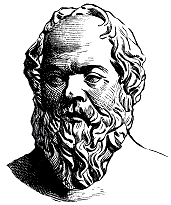
<a href="http://worldartsme.com/">WorldArtsMe</a>


“So let us take up from the beginning what the accusation is, from which has arisen the slander against me. ..... What did the slanderers say to slander me? Their sworn statement, just as though they were accusers, must be read: “Socrates does injustice and is meddlesome, by investigating the things under the earth and the heavenly things, and by making the weaker speech the stronger, and by teaching others these same things.” ... ...You yourselves also used to see these things in the comedy of Aristophanes: a certain Socrates was carried around there, claiming that he was treading on air and spouting much other drivel about which I have no expertise, either much or little. And I do not say this to dishonour this sort of knowledge, if anyone is wise in such things; but in fact I, men of Athens, have no share in these things.”

16 October 2016

October meeting on letting go of worry, with a rousing chorus from Port Isaac’s Fisherman’s Friends #unitarians


We had a lovely meeting on Sunday 9 October, with the theme “Don’t worry!  Be happy!”  Using our Unitarian freedom, the order of our service was changed, with our usual sharing ritual near the end instead of the beginning, as a means of cementing what had gone before.

As usual, at the start, we had a space in which participants were invited to silently centre themselves and go through in their own minds why they had chosen to be there.  For myself, I usually use that space to recite my personal creed or to remind myself of the insights or intuitions I had most recently received through my personal lectio divina activity.

We then had an opening prayer (or reading) from Kalidasa, an ancient Hindu writer, reminding us to look to this day so that all our yesterdays become a dream of happiness and all our tomorrows comprise a vision of hope.

After a hymn including the words of Sydney Henry Knight: “We do not seek a shallow faith, A God to set us free from trial and error, harm and death....But strength that we may cope...[and] trust the Life invincible within”, we lit our candles of concerns and joys.  This was a cherished time, during which we spoke in the safe space we had managed to establish.

We then had our scripture readings.  We heard words attributed to Jesus from the lost gospel known as “Q”, in which he challenged his followers to stop worrying, as worrying cannot add a single moment to their lives.

We next heard the Buddha’s teaching on causation and circumstances.

We sang another hymn reminding us not to grieve though life be full of sadness, and then we heard the president’s reasons for choosing the two readings from Jesus and the Buddha.


“Jesus deals in emotive pictures, touching the heartstrings.  The Buddha provides a cool, detached, theoretical and intellectual explanation.  Putting these two readings in different language, the first reading says that God has already dealt with what we dread, with the actions we have taken in our lives and the dreaded consequences (though Jesus doesn’t say how).  The second reading says that what has happened, and what will happen, are all included in the natural order of things.  Sometimes the emotional answer is what we need to hear, and sometimes the logical theory gives us more.”

To get down to the nitty-gritty, we then heard a few examples of hints and tips about “not worrying, and being happy.”  One particularly striking one had been derived from Aldous Huxley: we all crave separateness and then as soon as we have grown into separateness we crave peace.  But we can’t have both peace and separateness, so if we want peace more than we want separateness we have to learn to undo our separateness again.


After our seven minute period of silent meditation we heard the prayer poem by George Herbert, “Come my way” and we finished off with a rousing song from Port Isaac’s Fisherman’s Friends “Come all you no hopers, you jokers and rogues.” Hear and watch it here: https://www.youtube.com/watch?v=AYA_0R7Vw1s

Come, all you no hopers,
you jokers and rogues
we're on the road to nowhere,
let's find out where it goes
It might be a ladder to the stars, who knows
Come, all you no hopers,
you jokers and rogues.

Leave all your furrows in the fields where they lie
Your factories and offices;
kiss them all goodbye
Have a little faith in the dream maker in the sky
There's glory in believing him
and it's all in the beholder's eye.

Turn off your engines and slow down your wheels
Suddenly your master plan loses its appeal
Everybody knows that this reality's not real
So raise a glass to all things past and celebrate how good it feels.

Awash on the sea of our own vanity
We should rejoice in our individuality
Though it's gale force, let's steer a course for sanity