18 April 2017

April 2017 meeting for reverence – recognising and staying with suffering, showing respect to others Ringwood #unitarians

Our meeting for reverence this month was held on 9th April, celebrated by western Christians as Palm Sunday.  That’s the day when it is remembered that Jesus of Nazareth was celebrated and welcomed as potentially the leader of a new order as he arrived in Jerusalem, prior to the most important feast of the Jewish year, the Passover.  In Judea at the time many were asking questions over the just exercise of power, and the right to self-determination.  Questions which should not go away and which must continue to be asked, as lessons from even recent history are gradually forgotten.  It was thought that Jesus was going to confront ruling interests with these questions.


Over a number of our gatherings recently we have been expressing our concern and dismay at the turmoil caused by dissension, division, disagreement, conflict and war all around the globe at the moment.  And that is on top of what could be thought of as the ordinary sadnesses, chaos and upsets experienced in domestic and family settings.

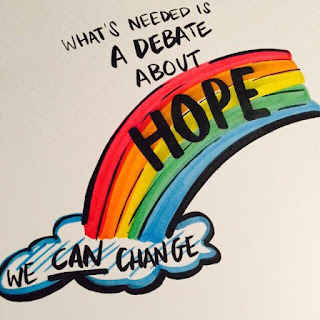

It would be possible to feel, and act, as if powerless under these circumstances.  Rather, in this meeting, we exercised our option to face it, square on.

We reflected on staying in the discomfort of recognising suffering, showing respect to others by acknowledging it.  Unusually for us, both our readings came from the Christian heritage; specifically, the Gospel of Mark.  The first was the section on the triumphant entry into Jerusalem, and the the second was on the subsequent agony in the garden of Gethsemane. 

"The key to meditation is learning to stay."


After our period of silent meditation, a practice which figures in many world faith traditions, we sang hymns of peaceful resistance (“Kum-ba-yah,” and “We will overcome, some day”). 


13 March 2017

March 2017 meeting for reverence - balancing individual responsibility with letting go #unitarians

We had a beautiful meeting for reverence this morning which was centred around two extracts from the book "When I See the Wild God"  When I See the Wild God : Ly de Angeles : 9780738705767  

The chalice lighting words were an invitation to stand together with all others everywhere who were meeting together today in their search for truth and justice in freedom, living a life mindful of the divine.

The readings drew to our attention the connections we have with physical creation, through our bodies, and with both the overarching and more local human cultures we live in, through narrative, knowledge and experience.  A new idea to some of us was that our bodies have lived since the beginning of time and will live after our death to this life on Earth (as every atom in our bodies has been around since the beginning of time).  The difficulty in reconciling the ideas of “the one” and “the many” were remembered, with particular reference to J. R. R. Tolkien’s The Silmarillion


We were invited to consider the balance that has to be struck between

being part of the unending creation song (so being able to relax in the knowledge that our own pain, turmoil, joy and love do not actually stop the enduring song of creation)
and
the duty to be authentic, each moment, each decision, to the person we believe ourselves to be (no matter how hard that may be).


We sang some lovely little hymns, hidden gems in the Hymns for Living hymnbook; and were invited to spend our seven minute meditation time reflecting on how we had contributed to the creation song in the past week, and how we might attempt in the coming week to live authentically in line with who we believe ourselves truly to be.


We also lit candles for the things that concern us or which are current joys, and enjoyed a good conversation over coffee afterwards.  Our wide-ranging conversation pivoted around the concept of long-lived relationships, in family, friendship and – interestingly – commercial terms; and how modern day living seems to care little for loyalty.

We wondered how the current fashion for changing employment, leaving our family roots, and losing touch with friends from adolescence will affect society in the future.  And we concluded with the hope, if not complete trust, that people will always find a way to grace and happiness if they want to, regardless of the prevailing social conditions.


16 February 2017

Feb 2017 meeting for reverence on 'Church in today's world' #unitarians

Our meeting for reverence on 12 February 2017 reflected on the way faiths might relate and react to recent worldly affairs, looking especially at some recent Unitarian perspectives.


The opening words had been supplied by the International Council of Unitarian Universalists for use at February meetings and services, and included the words: May the light of this flame remind us of the path of peace and wisdom. 
A meditation from Aberdeen Unitarian Church then asked us to contemplate world peace, as measured in terms of the safety of children and those who are vulnerable.


We had a reading from the Unitarian minister Gabor Kereki, who wrote in 1968 that Churches are empty because they have lost contact with the real and living world.  His view was that religion without involvement in society is not effective religion; and also that action and involvement in society without a spiritual basis is dangerous, as shown by European history in the first half of the 20th century.  He said that Churches are “to combine pure religion with applied religion – to bring the values of the spirit into human life.”


This led to a reflection on what might be meant by “pure” and “applied” religion, and how those words are not simply placeholders for the words 'interior' and 'exterior' religion.  It was proposed that what might count as “applied” religion can be common to a range of world faiths, whereas what might be thought of as “pure” religion for each of them is quite different.
 

“Applied” religion is religion at work in the world as compassion, involvement, engagement, humility in relationships.


But “pure” religion is distinctive and could be thought of as what differentiates one faith from another.


So what might a “pure” religion be for a Unitarian?  This is quite tricky to answer as the faith and beliefs of Unitarians differ widely.


The second reading came from Fran Pickering, who is thought to be a Unitarian in the north-west of England.  Fran suggested that a favourite Unitarian perspective is to look at existence as an interdependent web of consciousness, both metaphorically and metaphysically.

At the electromagnetic level, that web is a web of power, and its energy can be characterised in terms of frequency. 


“Only as we, collectively, change the energy frequency of that web, by our own energetic acts of love and compassion, and by our own emanations of love into the frequency field, will the overall level of ‘consciousness awareness’ change for the better....... Peace will come when our love vibration is so strong, when our intent that the Earth be a garden of joy is so powerful, so clear, so uncompromising that the consciousness of all beings will be touched and changed.”


Our meeting included some hymns reminding us that Churches are not temples or shrines but fellowships, and that "the seekers of the light are one in the freedom of the truth" (Longfellow).  Towards the end of the gathering we heard from Kahlil Gibran (The Prophet)on our mutual dependence as we progress towards our god-self – everyone playing their part, with no room for inattention, detachment or smugness.

And we carried out our annual Muster at the end of the meeting, so that we now know who wants to be fully involved with decision-making for our Didymus society in 2017-18.  That is our local way of being involved in our little society, based on our spiritual explorations and leanings.