(This is the fourth in our continuing series examining the wording of the traditionally Christian "Apostles' Creed" in a fresh way.)
Abba, Father
[God’s title of “Abba, Father” is only found referenced in the Bible three separate times, in the passages of Romans 8:15, Mark 14:36, and Galatians 4:6, which are all in the New Testament. Only two speakers utter these words in these passages: Jesus and the apostle Paul. The word Abba is an Aramaic word that means “Father.” It was a common term that expressed affection and confidence and trust. Abba signifies the close, intimate relationship of a father and his child, as well as the childlike trust that a young child puts in his “daddy.”]
I am going to use the words name and title interchangeably here. Though, be ready; I really want to be talking about title, even if I slip back into ideas around name.
I want to flag that fact, right up front and central; because whilst I always mean title, a way of saying something about ‘things’, a way of expressing a relationship of ‘things within a structure’, it is more common for us to talk in terms of name. I am not looking to veer off into specialist language or make this jarring to read, but for the sake of honesty I want to be clear that this is what I mean. Titles are bestowed from the outside; whereas the name is not just of them but from them.
A name, in the true sense, is personal. A name is how we address someone we know. If we’re lucky, the name by which we address someone also happens to be the name they know themselves by. But this isn’t universally the case. Does your cat really think his name is “Spike”? Isn’t he, in his own understanding, “Cunning and Stealthy Hunter of the Night”? A name is not as simple as what someone is called by, alerted by, invited by; it is how they understand themselves and it is how they give themselves to others. Often the name we receive at our beginnings in our community — as if it were indeed a title — is one we grow to fill. For most of us it may become synonymous with the name in which we give ourselves to others; it may become integral to how we see ourselves. But equally we can adapt it, even change it. We tell others what our name is, no matter it may not originally have been our choice, no matter who may have given it to us first. More seriously than “Spike” the cat, and perhaps of more relevance: is the name you gave to your son at birth the name she knows herself by (and has she yet told you her true name)?

Whereas, titles are about relationships: in fact, relationships are inherent to titles. A community can teach us titles, because titles, like other jargon, are learnt by use within those communities. We can all use the titles of our community, they belong to all of us, but the name is something given to us each personally. “Please call me ‘Fred’,” is reserved for particular people within the community.
However, even the titles we learn in our communities can become names — but they can only become names through a living relationship. Then the name, unlike the title, is something we cannot share with others because it is not the sound of the word or the shape of the writing that creates the relationship, it is that living relationship that transforms that title into a name. As an example: we call God by the title ‘Father’ in the Lord’s Prayer but it is the ‘Our Father’ of praying as a community. For it to become ‘My Father’ — well, that is not something that can be taught or even tested from the outside: that is a matter of the lived relationship and personal experience in prayer.

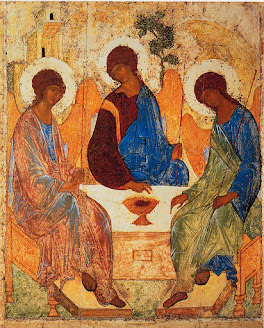
There is possibly no better cipher or symbol for this than the traditional Christian ‘Holy Trinity’. God is three and one, said to be truly one and also truly not only one. If we are personally able to use this frame of reference, immediately we are faced with the real inability of even our most basic concepts — “one” and “many” — to be applied in an exhaustive or limiting way to that which we call God. Moreover, we are not only faced by this reality: if this is our language, we face this reality without withdrawing from being able to speak about God at all. We embrace being able to say something, while also embracing that there is always so much more than what we have said.
But there’s more: in the Holy Trinity we also encounter God as relatedness (for more on this, explore the writings of Gregory of Nyssa), in which the titles ‘Father’, ‘Son’, and ‘Holy Spirit’ all refer back to each other, and are understood in view of each other. This framework suggests that the ways of relating to God are many, not because they can be but because they have to be. Each and every one does not stand alone but implies the others too.

This is not the place to develop a theology of the Holy Trinity, though there is a rich and beautiful tradition to draw on, which many Unitarians have neglected, that delivers a treasure trove of insights about relating to God, in the light of God’s self-relatedness. Similarly, in the Hindu tradition, inherent to the universe is the relationship of Brahman the unmanifest potential of all that can be, sometimes known in the west as the Godhead, and Atman the manifest, the created, the ensouled God. And in respect of this all-pervading relatedness, there is a wonderful Hindu saying:
'You think that you understand TWO because you understand ONE, and ONE AND ONE MAKE TWO; but first you have to understand AND.'
For now I just want to make the point that in the same way ‘God’ as a no-name holds the place for that experience of the insistence on more , ‘Trinity’ holds the mind back from reductionist descriptions of the Divine and from mistaking any of God’s names as being exhaustive.
The Apostolic Creed is in many ways an expansion of the idea of the Holy Trinity, not just in form (though there it is most clear), but also in reflecting on the meanings of each of the names of God given in that formulation.

How often do we get caught up in having to outline what we mean, and what we don’t mean, when we talk about or to God, in community? We reach around, looking for shared experiences to draw on, and often find that for every good feeling invoked by a name there are profoundly negative experiences linked to it too. We can find ourselves trying to use novel names or lengthy work-arounds which provoke responses we don’t intend — or which simply leave people cold. Understood correctly, the moniker of Holy Trinity gets in there right from the start with the provisos, and moves our communitarian speaking of and to the Divine out of the realm of our many and varied personal associations with names; moves our speaking of and to the Divine into a place of a shared understanding of titles, and how they relate to each other and not just to us personally.
For some people, the experiences of their life may mean they never experience God in their lives as the ‘Abba, my Father’ of Jesus praying alone, but that doesn’t prevent them from honestly reciting the words ‘Our Father’ with the community. Nor does it mean that they can’t experience the private intimacy in prayer that the words ‘Abba, my Father’ reveals.

We fear that the way we talk to and of God in our communities will exclude and marginalise. That concern is born of love, and of the awareness of how differently people can experience the world. Yet the truth that no name, taken alone, exhausts the Divine — and that how we learn in community to talk of and to God is the starting point not the end of our own lived relationship — can set us free from the knots we tie ourselves in. To say ‘God is Father’ is to say something but not everything; it is to affirm something but not to exclude everything else; it is to indicate something but also to draw attention to there being more. The Holy Trinity helps us keep our minds as open as we want our hearts to be, so that we can share in community not by ignoring diversity of experience but by embracing a shared context and a profound respect for God in the lives of each and every one of us. I believe in the Holy Trinity.