Showing posts with label God. Show all posts

18 February 2024

On 18 February 2024 #Unitarians in Ringwood made God laugh

On 18th February 2024 we say "Happy 10th Anniversary!" to Didymus.........

........And what an anniversary it turned out to be.


Early in the week beforehand it seemed that there would not be enough of us available to make a gathering worthwhile, and certainly not a gathering led by a guest preacher who would need to make a three hour return trip by car to be with us.


And so there was no gathering in Ringwood today.


For some of us, that was not a surprise.  For others, it was absolutely a surprise.


And as for those who made alternative plans, involving meeting together elsewhere – well, they found that despite best intentions, that didn’t work out happen either.


And so, what’s the spiritual learning we harvest from today?


It’s best summed up in this old joke:


11 December 2020

God the ruler of everything - continuing the review of the Apostles' Creed

((Blog editor's note:) Another in the series from one member of our group, looking at the Apostles' Creed in segments.) 


Pantocrator - The ruler of everything

[ From Latin pantocrator, from Hellenistic Ancient Greek παντοκράτωρ (pantokrátōr). ]


‘I believe in God, the Father, the Almighty, Maker of Heaven and Earth’, and I’m not going to lie: that hasn’t always been easy.  With so much suffering in the world, so much wrong, so much pain and hunger, and sheer incomprehensible darkness, this doesn’t just come across as hard to swallow — it comes across as downright offensive.  I have wrestled with the triad of all-knowing, all-powerful, and all good, and am very aware that that is a circle that cannot be squared no matter how much freewill you apply.  I have clung to the mystery writ large by the Book of Job and felt my fingertips slipping.  I have denied a Creator and braced myself against the cold winds that blew through my life thereafter; and then somehow, without even realising it, I have come to see that I was wrong.

In the West, we have culturally spent so much time proving God’s existence via tried and tested arguments from the world around us, that we have lost track of where our stories about God have come from.  I could not accept a Watchmaker who set things in motion then watched and washed their hands.  I could not respect a Creator who set us up to fail, or an abusive figure who doled out arbitrary rules, which were always going to get broken, and who seemed to relish in an overkill of retribution and punishment.  That God I had to hate, or I had to believe didn’t exist.

Well: that God doesn’t exist, yet tragically the tradition that talks God up is so mixed in with our Western cultural tradition (witness the classical terms I have used in this piece) that we don’t recall that that is not the God that we experience, nor is it the God revealed in the persona of Jesus.


To answer questions, of where the world has come from and why this or that happens, we have built up logical arguments and extrapolations that seek to make the world, and to make God, more intelligible — but in so doing we have lessened them.  Our tradition is rooted in the Bible, rather than the Upanishads, the Pāli Canon or the Qu'ran.  As, over time, we have treated the Bible like a book of information, not inspiration, in so doing we have set pitfalls for our own faith.

The Bible isn’t given us to answer our questions of natural science, geography, or history.  We have other stores of experience, sources of evidence, and the wonder of the questioning mind, to deal with such things. The Bible is a store of spiritual experience, a treasury of moments and characters that have inspired countless generations.  It is a tapestry and mosaic that brings together countless people over time and space.  It is something living, something amazing; we look to it for signs and clues, not simple facts — it is inspired and inspiring. 


When God creates in the Bible we do not see God at the ex nihilo [Latin for “creation out of nothing”] moment of bringing forth from nothing. The ‘beginning’ in the Bible is a beginning point from which to tell the tale. En Arche [the ancient Greek words at the start of Genesis, and the Gospel of John, with the primary senses of “beginning", "origin" or "source of action”] bears resemblance to our fabled  ‘Once upon a time’: it tells you this is where the story starts, what has gone before doesn’t matter, you don’t need an exact date to place it, its relevance isn’t limited to a single instance.  There are multiple ‘beginnings’ in the Bible; that isn’t a problem, as they are all places to begin telling the tale, the greatest Tale, the story of God and humankind. 


The Bible doesn’t say anything about how God made the world, but it tells us again and again that God is what makes the world possible.  God is what sustains everything, everything we see in flux, no single thing constant and remaining, all things distinct yet somehow united: God is what makes the many and the one possible.  The God that we cannot see in God’s many and oneness, yet revealed in the world.  We do not know God apart from the world; we cannot talk of a time where God sat and planned, before the world came into being.  It is in and through the world around us, the world we live in, the body’s world, that we know God, the God ‘in whom we live and move and have our being’ (Acts 17:28). 

We do not encounter the world as a question, no matter how much we may question the many things in it and that happen here.  We are accustomed to try to ask ‘who made the world?’ because we have permitted ourselves a sense that this will validate our belief in God and all that comes from that.  It won’t and it doesn’t.  Trying to separate our experience of God from our experience of the world digs a chasm we cannot cross.  When we ask about 'why the world’ we are asking about some certain part of it, something we can imagine or point to, and in every instance, we do not need ‘God’ as the answer to that question.  The question about ‘why is there something rather than nothing’ answers itself: because there is. 


Left to ourselves the world would present itself as a fact, a reality to be got on with, in the way other animals do; but the Bible, when it tells us about Creation, presents the world as something else.  The world becomes a sign, not just a fact.  The Bible is inspired by that God revealed in the world, and the Bible inspires us to see God there.  Those first two chapters of Genesis tell a tale that will be referred back to again and again throughout the Bible: God walking in the garden with humankind, God looking for us, us hiding from God, choices and consequences, change but ever the same. 


I believe in God the Almighty, omnipotent, the source of all potential, all that might be.  God is not a wizard or an Olympic lifter; the bearded guy in the clouds is too little, the Watchmaker too mean.  I could not believe in those puppets and shadows, but I can embrace a certainty that everything comes from something, that everything is held together and somehow in all its multiplicity is one.  I can believe in God as all that might be, more than all that is and ever was but the foundation of it all the same.

I believe in God the Maker of Heaven and Earth.  I do not know the how of things but I do know that the world, as the Bible tells it, was made for God to walk in with humankind, and I know that that has never changed nor ever will, no matter how often we hide, or how often the plan seems to go wrong. 

I can find answers with my reason for all manner of things that happened in the world, choices and consequences, both foreseeable and not so.  I know that understanding why something happened doesn’t make it ok — we can learn from it but that doesn’t change it or expunge it.  But that’s consistent, because we don’t encounter in the Bible a God who makes everything ok, a God who protects all the righteous and deals out comeuppance to the wicked, quickly and easily. We do not find a God in the Bible who has a store of good things if you just ask nicely enough, if you just believe strongly enough.  We do not encounter such a God there, just as we do not encounter such a God anywhere.  If we struggle to believe in God as the Almighty and the Maker of Heaven and Earth, perhaps the question we should be asking is not ‘have we been betrayed by God’ but ‘have we betrayed ourselves and others by preaching a deity who never was’.  The God of the Bible is ever present not separate from the world.  The God of the Bible is seen in the world acting through those who answer God’s call.  God is shown looking for us, walking with us, talking to us. 

If you struggle to believe in God the Almighty, perhaps it’s time to ditch ‘God of the-ATM-in-the-sky and get-what-you-deserved-on-earth’.

I believe in God the Almighty, Maker of Heaven and Earth.


07 August 2020

God the Intimate - Abba, Father - rich and contemplative provisos

(This is the fourth in our continuing series examining the wording of the traditionally Christian "Apostles' Creed" in a fresh way.)

Abba, Father

[God’s title of “Abba, Father” is only found referenced in the Bible three separate times, in the passages of Romans 8:15, Mark 14:36, and Galatians 4:6, which are all in the New Testament. Only two speakers utter these words in these passages: Jesus and the apostle Paul.  The word Abba is an Aramaic word that means “Father.”  It was a common term that expressed affection and confidence and trust. Abba signifies the close, intimate relationship of a father and his child, as well as the childlike trust that a young child puts in his “daddy.”]


I am going to use the words name and title interchangeably here. Though, be ready; I really want to be talking about title, even if I slip back into ideas around name.

I want to flag that fact, right up front and central; because whilst I always mean title, a way of saying something about ‘things’, a way of expressing a relationship of ‘things within a structure’, it is more common for us to talk in terms of name.  I am not looking to veer off into specialist language or make this jarring to read, but for the sake of honesty I want to be clear that this is what I mean.  Titles are bestowed from the outside; whereas the name is not just of them but from them.

A name, in the true sense, is personal.  A name is how we address someone we know.  If we’re lucky, the name by which we address someone also happens to be the name they know themselves by.  But this isn’t universally the case.  Does your cat really think his name is “Spike”?  Isn’t he, in his own understanding, “Cunning and Stealthy Hunter of the Night”?  A name is not as simple as what someone is called by, alerted by, invited by; it is how they understand themselves and it is how they give themselves to others.  Often the name we receive at our beginnings in our community  — as if it were indeed a title — is one we grow to fill.  For most of us it may become synonymous with the name in which we give ourselves to others; it may become integral to how we see ourselves.  But equally we can adapt it, even change it.  We tell others what our name is, no matter it may not originally have been our choice, no matter who may have given it to us first.  More seriously than “Spike” the cat, and perhaps of more relevance: is the name you gave to your son at birth the name she knows herself by (and has she yet told you her true name)?


Whereas, titles are about relationships: in fact, relationships are inherent to titles.  A community can teach us titles, because titles, like other jargon, are learnt by use within those communities.  We can all use the titles of our community, they belong to all of us, but the name is something given to us each personally.  “Please call me ‘Fred’,” is reserved for particular people within the community. 

However, even the titles we learn in our communities can become names — but they can only become names through a living relationship.  Then the name, unlike the title, is something we cannot share with others because it is not the sound of the word or the shape of the writing that creates the relationship, it is that living relationship that transforms that title into a name.  As an example: we call God by the title ‘Father’ in the Lord’s Prayer but it is the ‘Our Father’ of praying as a community.  For it to become ‘My Father’ — well, that is not something that can be taught or even tested from the outside: that is a matter of the lived relationship and personal experience in prayer.

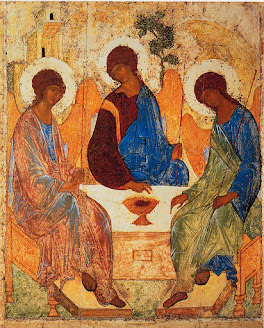
There is possibly no better cipher or symbol for this than the traditional Christian ‘Holy Trinity’.  God is three and one, said to be truly one and also truly not only one.  If we are personally able to use this frame of reference, immediately we are faced with the real inability of even our most basic concepts — “one” and “many” — to be applied in an exhaustive or limiting way to that which we call God.  Moreover, we are not only faced by this reality: if this is our language, we face this reality without withdrawing from being able to speak about God at all.  We embrace being able to say something, while also embracing that there is always so much more than what we have said. 

But there’s more: in the Holy Trinity we also encounter God as relatedness (for more on this, explore the writings of Gregory of Nyssa), in which the titles ‘Father’, ‘Son’, and ‘Holy Spirit’ all refer back to each other, and are understood in view of each other.  This framework suggests that the ways of relating to God are many, not because they can be but because they have to be.  Each and every one does not stand alone but implies the others too.


This is not the place to develop a theology of the Holy Trinity, though there is a rich and beautiful tradition to draw on, which many Unitarians have neglected, that delivers a treasure trove of insights about relating to God, in the light of God’s self-relatedness.   Similarly, in the Hindu tradition, inherent to the universe is the relationship of Brahman the unmanifest potential of all that can be, sometimes known in the west as the Godhead, and Atman the manifest, the created, the ensouled God.  And in respect of this all-pervading relatedness, there is a wonderful Hindu saying: 

'You think that you understand TWO because you understand ONE, and ONE AND ONE MAKE TWO; but first you have to understand AND.'


For now I just want to make the point that in the same way ‘God’ as a no-name holds the place for that experience of the insistence on more , ‘Trinity’ holds the mind back from reductionist descriptions of the Divine and from mistaking any of God’s names as being exhaustive. 

The Apostolic Creed is in many ways an expansion of the idea of the Holy Trinity, not just in form (though there it is most clear), but also in reflecting on the meanings of each of the names of God given in that formulation.


How often do we get caught up in having to outline what we mean, and what we don’t mean, when we talk about or to God, in community?  We reach around, looking for shared experiences to draw on, and often find that for every good feeling invoked by a name there are profoundly negative experiences linked to it too.  We can find ourselves trying to use novel names or lengthy work-arounds which provoke responses we don’t intend — or which simply leave people cold.  Understood correctly, the moniker of Holy Trinity gets in there right from the start with the provisos, and moves our communitarian speaking of and to the Divine out of the realm of our many and varied personal associations with names; moves our speaking of and to the Divine into a place of a shared understanding of titles, and how they relate to each other and not just to us personally.

For some people, the experiences of their life may mean they never experience God in their lives as the ‘Abba, my Father’ of Jesus praying alone, but that doesn’t prevent them from honestly reciting the words ‘Our Father’ with the community.  Nor does it mean that they can’t experience the private intimacy in prayer that the words ‘Abba, my Father’ reveals. 


We fear that the way we talk to and of God in our communities will exclude and marginalise.  That concern is born of love, and of the awareness of how differently people can experience the world. Yet the truth that no name, taken alone, exhausts the Divine — and that how we learn in community to talk of and to God is the starting point not the end of our own lived relationship — can set us free from the knots we tie ourselves in.  To say ‘God is Father’ is to say something but not everything; it is to affirm something but not to exclude everything else; it is to indicate something but also to draw attention to there being more.  The Holy Trinity helps us keep our minds as open as we want our hearts to be, so that we can share in community not by ignoring diversity of experience but by embracing a shared context and a profound respect for God in the lives of each and every one of us. I believe in the Holy Trinity.


28 June 2020

That word 'God'

In God

Do not be afraid.  

This is not the name used to coerce compliance to a set of rules, or used to open wallets for personal profit.  It is not the name behind which people doing bad things have hidden, or the name in which truly awful things have been done.  Some people have always tried to coerce compliance, to prey on the finances of others.  Some people have always sought to get away with doing bad things.  And history is full of people being truly awful.  There will always be people using anything that works to do these things; and we must not be blind to it no matter where or when it happens. ‘God’ didn’t make them do it, no matter how much our cultures and societies may have enabled it.  Those people need to answer for their crimes, and alongside that, other people need to recognise the abuses of systems and to change the systems.

God is not a name.

God is a no-name.

And I believe in God.

I believe in God the way I believe in Justice, in Truth, in Beauty, in Good.  When I say I believe in all these things I am not opening up a debate about their existence, as if I can point at them — or as if anyone would settle anything by pointing to a place where they were not.  I am not using the phrase to ward off responsibility for my words and actions, and I am not using it to give me an authority or power over others, though that can be done with any of those other things I believe in too.  When I say I believe in God I am sharing my experience of the world, and of something important to me about how I live in that world.  


When I say I believe in God I am witnessing to God’s insistence, not God’s existence (John Caputo, The Weakness of God).

Personally or in my community, I have never experienced God as a rare creature found only in particularly unusual habitats, of which tall tales are told and dubious sightings are shared in hushed tones.  My belief in God isn’t a scientific fact to be verified or falsified; it’s my witness to a lived experience of more.  The experience of an insistence that I try to be a better person, that I try to understand the world around me and my place in it better.  An insistence not limited to the will and wants of the people around me, not limited to my ease or preference, not limited to current success or bound by past failures.  An unlimited insistence that is neither without me nor within me (John Henry Newman, A Proof of God).  The experience of an insistence that there is something else just over the horizon, just behind that cloud, or around that bend.  The insistence that things go on, wherever I look.  This experience is subjective, in the sense I can’t ever separate myself from it; but it is objective in the sense that I do not choose it, it does not stem from me alone, and — more yet — it is at the core of everything I do or say. 


That which we call God is always more (Anselm of Canterbury, Monologion). Every time we alight on something and would call it God we are disappointed because it falls short (Plato, Phaedrus).  God is more: we experience God in the difference between how things are and how we feel they ought to be; between what we know and what we feel there is to know. 


God is more, which means for every title we give, for every description we use — however true, however just, however beautiful — there is always more, which it does not convey, than it conveys.  For every new insight that comparison reveals to us about God, it turns out that God is always more NOT like that, than God IS like that.  God is always more NOT as we imagine or intuit, than anything we fixate on God being. 


Not this.


Not this.


Not even this.

That very urge that makes you feel uncomfortable with the word ‘God’, that makes you want to shy away from using it, is your own witness to knowing that God is more than what ‘God’ is said to be.  I, too, do not assert an old man with a long beard on a cloud; I, too, do not assert an angry, joyless dictator.  I, too, can all too often see the human behind the curtain when ‘God the great and powerful’ is proclaimed, and am angry, and sad, at the abuse and the greed and the power-mad, wanton cruelty.  None of this will I call God.

God is the insistence that I cannot deny that these things are wrong, that we can do better, that things can be better, that there is always more.  God is not ‘this being the case because I want it to be’: God is more, and I believe in God.


12 April 2020

Easter Day 2020 – All shall be well

On the first day of the Jewish week after Passover, the first day it was permitted to move around after the festival, the women in the life of Yeshua went to retrieve and dress his body. 

But the body of Yeshua, the latest messenger of the justice and compassion of God, had gone missing. 


That sparked a whole new life for the story of Yeshua and — indisputably — launched and continues to launch new, clean, ‘begin again’ lives for countless millions ever since, to the present day. 

For myself, I find resonance with more oblique references to the mystery that is life; the notion of avatars (the material appearance or incarnation of a deity on earth) cannot engage me. 

A brilliant summing up was made by one of our group this past week: 

"I think there has always been a tension between the incarnate Word of social justice and lived truth, and the infinite well of being and possibility we live and move in.  I think doctrines like the Trinity are about bridging that experience without reducing one to the other or denying any part of it."

So, on the day celebrated by western Christianity as Easter Day, a model that means more to me, a model that makes me thrum like a plucked guitar string, is the model of the Hindu goddess Kali, wife of the god Shiva, and goddess of destruction and birth.  Known as the “dark mother”, Kali — a symbol only — symbolises the beginning and ending of being.  Sometimes depicted in her ferocious pose wearing a garland of skulls, she is said to devour karma — the endless ‘Groundhog Day’ cycle of death and rebirth conditioned by our careless, clumsy and stumbling actions — freeing us from its hold.


There is a beautiful devotional chant to Kali:

"Many names has our world Mother
Many dresses and many appearances.
I want to let you know my desire:
At the last moment of my life take me in your lap." 

And this chant, or prayer can be found here:


So on this day of new beginnings, what my Unitarianism tells me is that God has already encompassed or dealt with the dread consequences of our mis-steps; and Hinduism, Judaism and Christianity are merely three different ways of saying the same thing:  that in the end, “All shall be well, and all shall be well and all manner of thing shall be well.” Julian of Norwich

04 November 2019

Being a disciple of Yeshua, a teacher of 'oneness'


The thing about Unitarians is that we seldom stand completely in one camp.  Just as we rarely hold a vision in common about how the multiverse operates, we rarely confine ourselves to one community of faith.  Seeking guidance, help and inspiration from a wide range of human sources (experiential, emotional, artistic, historic, scientific, mystic; solo and collaborative) - and from environmental sources as we live as animals on this Earth - we also tend to wander freely between circles of influence in terms of faith teaching.

So it is a rare Unitarian who adopts a single, or even prime, teacher to guide their path.  A number of UK Unitarians are satisfied in labelling themselves Unitarian Christians, and in doing so are content to be seen as people for whom the Jewish rabbi Jesus (or Yeshua) is the prime reference.  But the practice and contemplation of Unitarian Christians is not exclusive to Yeshua - there is a wealth of guidance available under the generic “Christian” banner that has not directly come from the words or actions of Yeshua, but instead, has come in an indirect way, from the thoughts and actions of other followers of Yeshua who have gone before.

For myself, for instance, I have gained a lot from paying attention to the guidance of the Abbot Benedict, a Roman Catholic monk living in the sixth century, and the Rule for life in community which he crystallised for his monks; as well as from various contemporary commentators on Benedict.  But that feels a long way removed from the words I hear reported as coming directly from Yeshua, as written in the Bible.  I have learned from Christianity rather than directly from Yeshua; and so I do not really think of myself as a Unitarian Christian.

Now, because of my interest in Benedict, I belong to a Benedictine group, whose members alongside me are traditional Christians.  One of the books we are currently reading together is a book by Professor Rowan Williams, Being Disciples.  Unlike the rest of the group, in the reading of this book there is work for me to do, to translate terms, directed by the author at traditional Christians, into terms that seem to me to be universally applicable.  It is only by doing this that I can hold true to my Unitarian calling: I strongly feel that a teacher has been truly wise only if their teaching can be applied to all humankind, not to just a select grouping, or to a specific time.  ‘What is true everywhere, over all time’, worded also as ‘oneness of all humankind’, is crucial to me.

So I am now reading Williams’ Being Disciples with this question, this context in my mind:  Yeshua the teacher of ‘oneness’.  Because, if ‘oneness’ is the touchstone for a Unitarian, then a teacher will be helpful to the extent that they address the ‘oneness’ issue.

Williams suggests that being a disciple - a student of a teacher or guru - is not a set of ‘I can pick up-I can put down’ activities, but rather is a state of being; and that it requires staying in the company of the guru or teacher over long periods, even when nothing much seems to be happening.  It requires being attentive to the teacher, he says, and going with them even as they go to places you would not have chosen for yourself.  That bit is very important.

In Williams’ book we are reminded that Yeshua went to some places his contemporary followers found very uncomfortable; and that he received criticism for both his behaviour and for the company he kept.  From the ‘oneness’ standpoint, I see Yeshua deliberately taking action to challenge and break down the traditional divisions between people.  He taught, as well as showing by demonstration, that those granted power and authority over others should behave humbly and put the needs of others before their own needs: the famous foot washing (John, Chapter 13).  He broke taboos by eating and associating with people who were regarded as the dregs of Jewish society; and with despised collaborators with the Romans (e.g. tax collectors).  It is clear that Yeshua saw such exclusions as running counter to what is best in and best for humankind, and he demanded that those who followed him should set aside such barriers.  He emphasised an old teaching of non-exclusion in Judaism: that the very ingredient left on the side is the key element in the whole affair. (Psalm 118, quoted by Yeshua in Matthew, Chapter 21; Mark, Chapter 12; Luke, Chapter 20).

Yet - demonstrating to me his humanity - Yeshua was not himself perfectly consistent in living his message (and knew it: “Why do you call me good?  Only one is good, and that is God.” (Matthew, Chapter 19; Mark, Chapter 10; Luke, Chapter 18)).  He was challenged to reach out beyond his Jewish cultural habits: to a Roman soldier who sought healing for a member of his household (Matthew, Chapter 8), and to a Samarian woman at a well, whom at first Yeshua seemed reluctant to include (Matthew, Chapter 15).  Yeshua was stretched on both these occasions, but he passed the test of his own message - when the chips were down - by treating these others as he treated his own.


So Yeshua was looking for ‘oneness’ between all sorts of people.  And if we choose to use his teachings and example as our guide, we must work to break down barriers between people, and treat the last as first, even at the cost of placing ourselves in situations not designed for our own comfort.

~~~~~

But Yeshua’s teaching is not limited to ‘oneness’ of human society.  As a mystic, his teaching extends to relationships with God.

Prof Williams suggests that: “…The relationship of Jesus to the Father is not episodic.  Jesus does not receive an occasional bit of instruction from the Father; his relationship is sustained, eternal and unbroken.”

My own reading is that Yeshua is attentive to the divine reality in a continual way; an unending ‘oneness’ subsisting between him and what brought him into being and sustained him.  And then he extends that: he extends the ‘oneness’ between God and himself, to a ‘oneness’ starting with God and including himself then extending to his disciples: “I am the vine and you are the branches.” (John, Chapter 15).  “My Father, who gave them to me, is greater than all; and no one is able to pluck them out of my Father's hand.  I and my Father are one.” (John Chapter 10).  “Truly, I say to you, he that receives whomsoever I send receives me; and he that receives me receives him that sent me.(John Chapter 13). “No man knows who the Son is, but the Father; and who the Father is, but the Son, and he to whom the Son will reveal him.(Luke, Chapter 10).

It seems that Yeshua sees this experience of ‘oneness’ with truth and reality as both possible and essential, for anyone who wishes to follow the same path: “The Kingdom lies within you.” (Luke, Chapter 17). “Rejoice because your names are written in heaven.” (Luke, Chapter 10). 

And Yeshua uses the idea of God as Father, rather than Judge, to indicate the familial intimacy and connectedness that we should feel with God.  So Yeshua, the breaker of barriers between people, is encouraging his followers to see a continuum, not a separation, between their worldly being and the creative power, or will, that brings them into being.

And perhaps the most famous of all the teachings of Yeshua is this: “Thou shalt love the Lord thy God with all thy heart, and with all thy soul, and with all thy mind.  This is the first and great commandment.  And the second is like unto it: thou shalt love thy neighbour as thyself.  On these two commandments hang all the law and the prophets.”  (Deuteronomy, Chapter 6 and Leviticus Chapter 19, quoted together by Yeshua in Matthew, Chapter 22; Mark, Chapter 12; Luke, Chapter 10).

As Williams has it: “…so we in our discipleship [of Jesus] are summoned to gaze into the mystery of that infinite love and to seek to do that same eternal will: to ‘act’ that same action, on earth as it is in heaven, as the Lord’s Prayer puts it.”

~~~~~

So it seems to me that Yeshua is - among other things - a teacher of ‘oneness’: a ‘oneness’ stretching from the source of the multiverse, through the laws governing evolutionary environmental existence and human society (“heaven and earth”), through the compassion wisdom of the spiritual guides and the prosaic nature of ordinary life, to concrete expression in the most outcast, ignored and helpless of our kind and of animal kind.  Yeshua’s teaching infers a demand for an attentive recognition of the integrated web of relationship and interdependence, and this as part of an unending search for what is best in and best for humankind.

And again from Prof Williams, regarding what the actions and teachings of Yeshua can be used towards as we live today: “…what it’s all finally about is enabling you to do some very ordinary things a little bit better, in a way that is suffused by eternal love taking up residence in the heart…..what the disciple learns: how to be a place in the world where the act of God can come alive.”


10 September 2019

Just what IS the Good News, which the Bible speaks of? - #Unitarian view based on Isaiah and Mark

At our gathering last Sunday we were led by the president for the day to consider change to be the source of our hope for the future.  This report is one response to what was presented.

After gathering words by Rev Dr Linda Hart, and prayer based on words from John D Caputo, we had two readings, a musical interlude, a time of silent meditation and a simple ritual for those who wanted it.  And we sang two hymns.

But for me, this time, it was the readings that made it a gathering to remember.


First, there was a short reading from the Old Testament of the Christian Bible, Book of Isaiah chapter 52 verses 7 to 15, starting with: ‘How beautiful on the mountains are the feet of those who bring good news, who proclaim peace, who bring good tidings, who proclaim salvation, who say to Zion: “Your God reigns!”’

And the second reading came from the New Testament of the Christian Bible, Book of Mark chapter 1 verses 1 to 15, ending with: ‘Jesus went into Galilee, proclaiming the good news of God.  “The time has come,” he said.  “The kingdom of God has come near.  Repent and believe the good news!”’

Now I was immediately engaged with this combination of readings. I have long been told that “gospel” means “good news”, but for me all sorts of churches have been very woolly about exactly what the good news is.  For the most part, churches seem to say that the arrival of Jesus himself was the good news.  But when reading the New Testament I feel short-changed on that.  Whilst Jesus speaks several times of the Good News, he did not ever say anything like that.  Verses in the New Testament are more along the lines of ‘Jesus and his disciples went around preaching the good news’, without actually saying what that good news is.  The closest I have ever got to understanding it is in the Book of Luke, chapter 10, in which Jesus gives instructions to his followers to go out and spread the message.  He says (verse 9) that they are to say to people that “the Kingdom of God has come near to you.”  And in a reinforcing teaching in Luke chapter 17 verses 20 and 21, Jesus says:

`20 Some Pharisees asked Jesus when the Kingdom of God would come. His answer was, “The Kingdom of God does not come in such a way as to be seen. 21 No one will say, ‘Look, here it is!' or, ‘There it is!'; because the Kingdom of God is within you.”’ 

What happened on Sunday was that at last someone was giving me a clear idea about what the good news actually is.  It felt to me that the idea being put to us was that the good news is about God, not about Jesus.  That Isaiah was saying that the good news is that God is in charge and will comfort ruined people and redeem the brokenness.  And that, moving forward in time, when Jesus was talking about spreading the good news, he was repeating the news of Isaiah - that God is in charge and will mend brokenness - but over and above what Isaiah said, what Jesus said was that actually there’s no special time nor place for that, because that action of God is available all the time, inside each person.

What our leader for the day has helpfully provided me, for this report, is this:

"Essentially: we are living in a world where bad things happen, unjust things, terrible things.  For all the good and the beauty that we see, there is a constant threat of it all coming to a sudden and sticky end. And that is all we have ever known.

Yet right there with that, there is a voice saying that this isn't the way it is meant to be. Right there with all the misery, there is that relentless call to make things better, to change ourselves and the world we live in.  Sometimes it is gentle and sometimes it roars in the thunder.

The Good News we are called to believe in, right here, right now, is that, despite all the evidence to the contrary, things can be better, we can be better; and that no matter how often we fall, how often we fail, we can get back up.

That call, to a place where the voice that demands better is heard and made real, is the Kingdom brought near.  

And experiencing change in ourselves, and believing in that Good News, is ‘that which we call God’ happening in us, and to us, and through us."


I’m really grateful for the connections of thought that we heard on Sunday.  Wisdom teachers through the ages have taught us that there is always a way back from knots and disorder, to order and peace.  And that the changes we may experience in ourselves as we travel that way back may often look and feel like behaviours of compassion, humility, renunciation and attentiveness; attentiveness to the needs of those around us as well as to our own.  But surely these come later: the first step is to act on what Jesus and others have said: to trust the Good News that “change is possible and that things can be made better.”