Showing posts with label love. Show all posts

06 April 2023

A personal reflection on Maundy Thursday 2023


Bear in mind, dear reader, that this post, like all the posts on this blog, has been supplied by one of the Ringwood Unitarians – and not necessarily always the same one.  It should not be assumed that any other Ringwood Unitarian, or any Unitarian from anywhere, thinks or feels the same as this. Or that the rest of our Ringwood group are even interested in this train of thought.  That’s the beauty of any Unitarian community – we worship and we connect, but we don’t expect each other to think about the same things or to think or feel in the same way.


It’s Maundy Thursday today.  That’s the day of the Jewish Passover.  In the story of Jesus, the teacher Jesus and his students have gone to Jerusalem for the Passover festival.  This is a joyful and celebratory worship of the just and merciful God, who allowed the ancestors – Hebrew slaves in Egypt – to escape the deaths overnight of the first-born, which God inflicted on the then unresponsive, cruel slave-masters, the Egyptians.  It is the festival that recognises that God, or Life, will act kindly towards people who act in accordance with the edicts that God, or Life, demands.  The Egyptians were given their chances to comply, and chose not to.  So they suffered the loss of the first born of every female, human and other mammals.

This recognition – that Life acts kindly towards people who acknowledge its edicts – is found not only in Judaism but right through all the faiths, right across the spectrum of faiths, even in an oriental belief system that shies a long way away from the Jewish idea of a “personal God”, by which I mean Taoism.  Passover, or pesach, is a festival for everyone who has had a good experience of their faith.

So Jesus and his students, friends and family sit down to the Passover meal, the seder meal, to quietly await the arrival of the next day, the commemoration of the day when Hebrews woke up to find that God’s word had been carried out.  The morn when, of course, the Egyptians were shocked and frightened to find their first-borns had died, so before they retaliated in anger God warned the Hebrews to get out of Egypt very quickly.

Over that seder meal Jesus seems to be very sure that his time was coming to an end.  Perhaps he too is shocked and frightened; or perhaps he thinks that within a day or two it will be his followers who will be shocked and frightened.  You see, he has been in Jerusalem since the previous Sunday and he is aware that all sorts of people have all sorts of expectations of him that he will not necessarily fulfil. 

Some people want him to renounce some of the things he had said about relating to God.  Others want him to lead a zealous and possibly armed rebellion against the Roman occupying forces.  A few others seem to think he is bigging up his part as a wise man with a following, at the cost of wasting money that could better be spent on supporting the poor.  Jesus gets the vibes.  He knows the show-down is coming.  So he spends some time that evening over the meal reflecting back to his followers what it is that he stands for, and asking them to remember his words always – by tying them inextricably with the bread and wine of the seder meal, which he knows they will celebrate year after year, so they will have no occasion to forget them.

And in my reading of it, the message of Jesus is this.  We are in a covenant with God – which is an old Jewish message.  We are in a relationship, said Jesus, a relationship we cannot own or control – it’s a connection we can enter.  We are loved into being, we are all sustained by love throughout our lives, and we are received in love at our ending.  Jesus lives as if it were both task and gift to strive to echo that love, right up until his life's end. And he refers to the relationship as 'the kingdom of God' (Mark 1:15, Luke 11:20, Luke 17:21, Gospel of Thomas 11).

The kingdom of God, says Jesus, this relationship, the way to lasting life lived true to our best selves, lies within; and it is accessible to all.  But to find that kingdom, to enter into that ultimate relationship with the just and loving God, you have to be prepared to open your eyes to it, to let go of yourself, and act in all humility.  As though you and your wants and desires were all just by-the-bye, scarcely relevant at all.  

Jesus demonstrates that he thinks everyone, including the most acclaimed ones amongst us, need to see ourselves as fit for the most unpleasant and menial jobs; like taking off the sandals and washing the dusty, smelly feet of our companions after a day on the Galilean plains; like taking without comment an unwarranted slap across the face; like carrying the load of someone who chose to press us into service against our plans and expectations – and not just the mile they demand of us, but an extra mile too.

My message, says Jesus, is that we have to try to mirror God – who is in all people, including the most disadvantaged and disregarded, the ones cast out by the establishment, and the ones who self-injure by getting knotted up in their pain and difficulty.  The kingdom really is there to be experienced, but you have to work very hard to put yourself out of your own view, to put yourself gracefully out of everyone else’s way, and to be prepared – despite your fear – to relinquish your own comfort and control over what is happening to you.  Look, says Jesus, I mean we have to relinquish our own safety and comfort right up to the most painful and bitter end.  Right when it hurts most, right when we don’t think we can go on, we have to stand quietly in trust, and surrender ourselves in all humility to Life, to God – both in God's direct presence as we feel it, and as we feel it coming to us through other people.  Love the very people who cause you grief and pain, because God is in them too – it’s the only way to be fully human.

Despite the power of this mythic narrative, I can’t imagine the inspiration Jesus experiences.  But I can see what a strong man is being spoken of.  What serenity and peace and fulfilment he finds in his love for God and others.  How he disregards himself.  And, though at the end even Jesus feels abandoned, I can see that that doesn't prevent him from offering himself to God.  What a model.

So this Maundy Thursday I celebrate the life and message of the rabbi Jesus with the unleavened bread and the wine of the thanksgiving meal.

23 May 2021

Seek ye first the kingdom of God? #Unitarians in Ringwood gathering in May 2021

On 9 May 2021 we held our second gathering for reverence on Zoom, which took the topic “Seek ye first the kingdom of God”. After the welcome words, and the lighting of the chalice candle as usual, we were given some minutes of silence to privately focus in on what matters most to us and how we have lived up to that recently.

There were two readings from the book of the Hebrew prophet Samuel.


In the first reading the Hebrew peoples ask Samuel to institute a kingship and appoint them a king.  In the second reading we heard about the dilemma of Jonathan (servant to the king Saul and friend to David, of Goliath fame) when he was asked by David for protection against Saul.


Then there was a reflection on the two texts, and why they had been chosen to address the theme. There was a time for silent meditation; and then the opportunity to share intentions, concerns and hopes — during which tea lights and other candles were lit.


In the absence of any physical ritual that could be carried out together, Zoom allowed us to speak aloud together one of the formal set of words becoming traditional for the end of our gatherings:


We are aware, and we affirm, that we do not find our peace in the certainty of what we confess,

but in the wonder of what befalls us and what we are given;

that we do not find our destination in indifference and greed,

but in vigilance and in connection with all that lives;

that our existence is not fulfilled by who we are and what we possess,

but by what is infinitely greater than we can contain.

(Extract from 2006 Confession of Faith of the Dutch Remonstrant Church)

The reflection on the two texts against the theme “Seek ye first the kingdom of God” follows.


~~~~~~~~~~~~


“Seek ye first the kingdom of God”


Jesus of Nazareth speaks often of this kingdom, and for some of us that resonates or intrigues enough that it warrants some reflection. But I haven’t chosen a single reading where these words are said by Jesus. Why?


A gathering of ordinary Unitarians
 (some years ago)
Firstly, and foremost, it’s because these words aren’t given special status merely because a specific someone said them. Unitarians don’t pay attention just because someone deemed to be an authority says something.  Today we are reflecting on “seeking first the kingdom of God” but not because Jesus said so.  We are reflecting on it because to someone in our gathering it meant enough for them to put it forward as a topic for our time together.


Secondly, the readings from Samuel place the words “Seek ye first the kingdom of God” which are reported to be words of Jesus (in the books of Matthew and Luke), within the context, within the tradition, in which Jesus was raised and lived.  Traditions are important to Unitarians, because Unitarians set great store on ideas being tested for meaningfulness in a succession of lives, in lived experience within a group.  Unitarians don’t generally ascribe to the idea of a revelation arriving as a form of words, some divinely dictated prose or poetry, containing unworldly secrets no one could otherwise know.  Even mainstream Christian groups recognise that words and ideas, the very language that forms the basis of all inspiring scripture, exists within a context, within a tradition.


Thirdly, I have chosen these readings because just as “seeking first the kingdom of God” was spoken within the context of a tradition, so too that is how we hear it. We too stand within a tradition, both as Unitarians and as people growing up in the West.  Our tradition is one of the Bible, its stories, its sayings, parables and psalms and associated hymns and carols, cribs and crosses; but also a tradition of Paganism and science (some of which rubbed off into Europe from the Islamic knowledge-base of the Moors), myths, pan-European history, art, architecture, customs, certain ways of doing things —  even our political system. Traditions aren’t ‘pure’; they’re not closed off.   In the Bible itself we find Canaanite, Babylonian, Greek, Egyptian, and Roman influences, images, and ideas. These were the cultures and worlds — the traditions — that the people of the Bible, including Jesus, moved in. 

We shouldn’t be surprised, then, that our Unitarian tradition is open to Hindu, Earth Spirit, Buddhist, Taoist, Muslim, Jewish, Humanist, and many many other influences. What makes a tradition isn’t its ‘purity’, or its single source: a tradition is made by having a living thread of continuity.  We are not adrift, we are not unfocused scavengers here and there: we have our tradition.  And the choice of readings helps reflect that.


“Seek ye first the kingdom of God”

In our first reading (1 Samuel 8: 4-22a) we find Samuel being asked by the people to give them a king. Since their escape from Pharaoh, and in the days before they went back into slavery, the Hebrews were a people under God, a people of extended families managing their own affairs, with Judges who would arbitrate using God’s law to decide between standpoints when it was less clear who was in the right and the wrong. 

That way was failing as the people grew more numerous and new Judges became corrupt, so the people asked for a king. 

We see the kingship, the kingdom of God being placed on the one hand, and another kingship, another kingdom being placed on the other. We see the people turn away from God, his kingship, and his kingdom.
What we don’t see is any talk of heaven, any talk of reward and punishment in a future life. The kingdom is “here and now” choices, “here and now” ways of living.  

The kingdom of God is presented in opposition to the kingdom where the king takes the best for himself and his servants, where the king takes away the best of the land and puts people’s sons and daughters to work for his benefit not their own. 

The kingdom of God isn’t offered as a future time and place, away from all the injustice and exploitation we see around us: it is a choice we are asked to make now, a way of living we are asked to embrace here. 

In this first reading it is clear that the kingdom of God, which Jesus the carpenter’s son asks us to seek, isn’t in the clouds — it’s in the dust of the everyday.  This would have been well understood; those who heard Jesus speak would have heard him within this context.  

Just the everyday life
 in which we are asked to seek the kingdom
If you are in any doubt, ask yourself why the Romans would condemn a man to death — the penalty for leading a non-violent rebellion against the state, against the Kingdom of Caesar — if all Jesus was talking about was heaven?
The kingdom we are seeking within our Unitarian tradition isn’t heaven, isn’t a place to defer justice to.


“Seek ye first the kingdom of God”

In our second reading (1 Samuel 20: 1-23) we have moved on a few years from the time when people asked for a king.  They were given King Saul.  But power, and possibly guilt, has slowly driven Saul mad, and the kingship is passing bit by bit to David. 

We join the story with Jonathan trapped in the middle. Jonathan’s father Saul is the rightful king, and Jonathan is bound to him by just ties of loyalty and filial love, but he is not blind. Saul is increasingly erratic and violent. Now David comes to Jonathan and asks for his help.

What David is asking could be seen as treason to the king, a violation of the laws of the kingdom, a betrayal of Jonathan’s father and the natural hierarchy.  But following the rules as laid down does not take Jonathan to where we leave him in this story. 

Jonathan pauses; and in that moment another kingdom breaks in, another rule of how to live.  Jonathan does not ask himself what the law says, or what custom dictates: he asks himself where does LOVE lead, what does RIGHT ask of him in this moment. 

Jonathan seeks first that other kingdom, that other way of living life, that kingdom of God. Yes, he knows the rules of the world he lives in, the laws of cause and effect, and he is not blind to what his choices could mean for him; but FIRST he asks himself what is RIGHT, what is LOVING, and then decides his course in this world, here and now. 

The kingdom of God isn’t an easier option we could follow instead of living in the real world; the kingdom of God isn’t a realm where we get to make well-intentioned choices and be free of any difficult consequences. 

What is right, what is loving, means nothing if nothing changes; it means nothing if things get worse while we wrap ourselves in good intentions. 

First, we make space for God’s kingdom, the rule of right, the rule of what is loving, then we make our choices to make that present in the here and now. Every time someone does that seeking, that kingdom is a little closer at hand for all of us.

Within our Unitarian tradition we can hear that call, we can make our choices; not adrift from the needs and the realities of the world, but here and now. 

The door to a fairer better world for all may be closed but we can knock; the way to Paradise may be lost but we can seek. The kingdom is always at hand.

“Seek ye first the kingdom of God”.


14 April 2021

Life with the neighbours — giving, but with no sense of condescension

As Chesterton wrote : ‘We have to love our neighbour because he is there – a much more alarming reason for a much more serious operation.  He is the sample of humanity which is actually given us. Precisely because he may be anybody he is everybody. He is a symbol because he is an accident.’  G. K. Chesterton, 'Heresy' (House of Stratus, Thirsk, 2001)

~~~~~~~~~

For only the second time, people who usually meet under the Unitarian umbrella in Ringwood (Hants, UK) met on Zoom on 11 April 2021.


We lit the candle in our chalice at the start of the gathering.


In the gathering there were prayer and blessing words from Rev David Usher, Rev Andy Pakula, Darren Canning.  We heard a suggestion from Marcus J. Borg on a relevant way to read the Bible, 'Reading the Bible Again for the First Time — taking the Bible seriously but not literally.'  The website  www.bibleodyssey.org had also been a help in preparation for the gathering.  There was music from www.smallchurchmusic.com and the Unitarian Musical Society.  There were two readings, and we were also given the space for private, personal prayer or meditation practice in the customary seven minute period of silence.


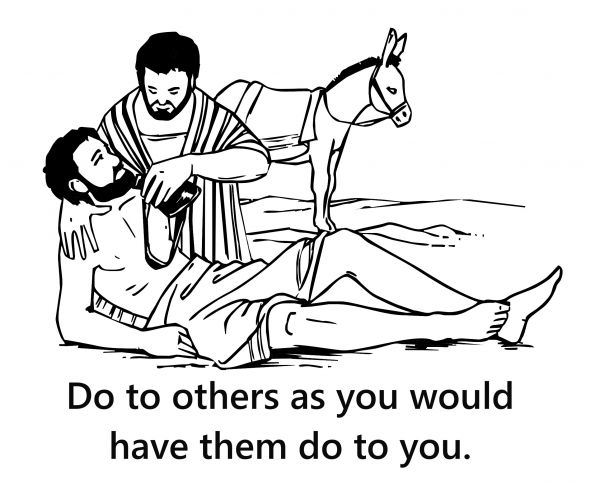
The first reading was from the Bible, taken from the book of Luke, chapter 10 verses 25-37, a story commonly referred to as 'The Good Samaritan', but which we now prefer to know as 'The priest, the Levite, and the Samaritan.'  The take home points were these:

  • Jesus presented the ethnic and religious outcast not only as the story’s hero but also as the moral exemplar and, because of the compassion he showed the person in need, the inheritor of eternal life — the one to imitate, should one be seeking to inherit eternal life.  The corollary implied by Jesus was that, on their showing that day, neither the ritually pure priest nor the Levite would inherit eternal life.
  • Jesus switched the question from, “Whom should I love?” which placed the recipient of the enquirer's love as an object to 'be done to', to “What must I do to show love — what am I prepared to risk to show love — what does it cost me to show love?”  In so doing, Jesus prompted the listeners to build in themselves the capacity for loving, independent of the identity of the recipient.  And to stop treating others as objects.
  • To label the Samaritan in the story “good” (a word never used in the text) is to participate in a racist assumption that being “good” is an unusual and noteworthy achievement for Samaritans.


The second reading was from 'Utopian Dreams: In Search of the Good Life' by Tobias Jones. 


Tobias and his wife Francesca took a sabbatical of a year from their usual lives and went away to find ‘the good life’ — something they could enjoy as an objective experience.  Yet while they were away their priorities changed; and they came back home to find instead a ‘good way to live’ — a way of actively being good neighbours.  So we heard again about the switch round of emphasis that Jesus had made.


When they got back home, Tobias and Francesca drew a circle of 1 km centred on where they lived, and searched out all the communities that were alive in that circle — which ones they could commit to being involved with.  We were invited to think about how their experience in localism relates to us and our lives today.  


We have all just experienced a great and shocking upheaval, and many people are re-thinking how they live and what their priorities now are.  We are discovering that there is such a thing as living much closer to home, literally.  That it is actually possible to do that, even if as yet we don’t necessarily find it the most enjoyable thing to do.  There have been some very big political issues in the past five years that have dominated the UK public sphere; but now that we may be nearing the end of the COVID pandemic we simply have to return to something much bigger, which is staring us in the face: the climate emergency.


There is much that only governments, commerce and industry can do to restructure, so as to put the brakes on carbon emissions; nonetheless, we all have a part to play.  We may not see the victims lying by the side of our road, beaten up and bleeding; but the climate emergency has victims.  So if we learn from Jesus the way to live a good life, we have to ask ourselves the cost and risk to ourselves — what we are going to have to change and give up in our own lives — of showing love to those victims.  (And, harking back to the discrimination against Samaritans by Jews of Jesus' time, we note that climate change, although something which will affect us all, is a deeply racialised phenomenon.  See the link to the Christian Aid website, below.)


Giving up our love of casual travel and the romance of the exotic may be part of the cost we have to pay, to secure the lives of those vulnerable to the effects of climate change. We may really all have to live right where we are, within a much smaller radius.  But like Tobias and Fran, we may actually find everything we need, right there.


~~~~~~~~


The Unitarian church in UK was (and remains) a founder member of the charity Christian Aid, and still has a stakeholder voice in the charity.  Find out here what Christian Aid has to say about the climate emergency: Our prophetic journey towards climate justice


01 April 2021

A personal view of Maundy Thursday


Bear in mind that this post, like all the posts on this blog, has been supplied by one of the Ringwood Unitarians
 – and not necessarily always the same one.  It should not be assumed that any other Ringwood Unitarian, or any Unitarian from anywhere, thinks or feels the same as this. Or that the rest of our Ringwood group are even interested in this train of thought.  That’s the beauty of any Unitarian community – we worship and we connect, but we don’t expect each other to think about the same things or to think or feel in the same way.


It’s Maundy Thursday today.  That’s the name the Christians gave to this day when a significant event for them took place, during the Jewish festival of the Passover.  Christians commemorate that on this day Jesus of Galilee gave the mandate (the Maundy) to his followers and students to carry on his work and to love each other as he had loved them.

The teacher Jesus and his friends had gone to Jerusalem for the Passover festival, for the celebratory worship of the just and merciful God.  At the Passover, Jews commemorate that God allowed their ancestors, the Israelite slaves in Egypt, to escape the horrors inflicted that night on their unresponsive and cruel slave masters, the Egyptians.  The horrors the Egyptians experienced was the overnight death of every first-born.  With the Israelites following the instruction to mark their covenant with God on the doorways of their dwellings, God did God's part of the covenant by passing over the houses of the Israelites, without inflicting death.

It is the festival that recognises that God, or Life, will act kindly towards people who act in accordance with the edicts that God, or Life, demands.  This recognition is portable from Judaism right through all the faiths, right across the spectrum of faiths, even to an oriental belief system that shies a long way away from the Jewish idea of a “personal God”, by which I mean Taoism.  Passover, or pesach, is a festival for all those who have had a good experience of their faith.

So Jesus and his friends and family sat down to eat their evening meal, to quietly await the arrival of the next day, the commemoration of the day when Israelites woke up to find that God’s word had been carried out – and the Egyptians were shocked and frightened to find their first-borns had died – and the Israelites now had to get out of Egypt very quickly.

And during that evening meal, Jesus seemed to be very sure that his time was coming to an end.  Perhaps he too was shocked and frightened; or perhaps he thought that within a day or two it would be his followers who would be shocked and frightened.  You see, he had been in Jerusalem since the previous Sunday and he was aware that all sorts of people had all sorts of expectations of him that he would not necessarily fulfil.

Some people had been truly offended to the core by some of the teachings he had given, and wanted him to renounce some of the things he had said about his relationship to God.  Others wanted him to lead a zealous and possibly armed rebellion against the Roman occupying forces.  A few others seemed to think he was bigging up his part as a wise man with a following, at the cost of wasting money that could better have been spent on supporting the poor.  Jesus got the vibes.  He knew the show-down was coming.

So he spent some time that evening over the meal reflecting back to his followers what it was that he stood for, and asking them to remember his words always – by tying them inextricably with the bread and wine of the meal on this Passover festival, which he knew they would celebrate year after year, so they would have no excuse to forget them.

And in my reading of it, the message of Jesus was this.  We are in a covenant with God – which was an old Jewish message.  We are in a relationship, said Jesus, a relationship we cannot own or control – it’s a connection we can enter.  We are loved into being, we are all sustained by love throughout our lives, and we are received in love at our ending.  Jesus lived as if it were both task and gift to strive to echo that love, right up until his life's end. 

The kingdom of God, said Jesus, – this relationship – the way to lasting life lived true to our best selves – lies within, and it is accessible to all.  But to find that kingdom, to enter into that ultimate relationship with the just and loving God, you have to be prepared to let go of yourself and act in all humility.  As though you and your wants and desires were all just by-the-bye, scarcely relevant at all.  Jesus demonstrated that he thought everyone, including the most acclaimed ones amongst us, need to see ourselves as fit for the most unpleasant and menial jobs; like taking off the sandals and washing the dusty, smelly feet of our companions after a day on the Galilean plains; like taking without comment an unwarranted slap across the face; like carrying the load of someone who chose to press us into service against our plans and expectations – and not just the mile they demand of us, but an extra mile too.


My message, said Jesus, is that we have to try to mirror God – who is in all people, including the most disadvantaged and disregarded, the ones cast out by the establishment, and the ones who self-injure by getting knotted up in their pain and difficulty.  The kingdom really is there to be experienced, but you have to work very hard to put yourself last, to put yourself gracefully out of everyone else’s way, and to be prepared – despite your fear – to relinquish your own comfort and control over what is happening to you.  Look, said Jesus, what I mean is we have to give up our own safety and comfort even if, and while, doing that may lead us to the most painful and bitter end.  Right when it hurts most, right when we don’t think we can go on, we have to stand quietly in trust, and surrender ourselves in all humility to Life, to God – both in God's/Life's direct presence as we feel it, and as we feel it coming to us through other people.  You have to love the very people who cause you grief and pain because God/Life is in them too: because that’s the only way to be fully human.

I can’t imagine the power of the inspiration Jesus had experienced.  But I can see what a strong man he was.  What serenity and peace and fulfilment he found in his love for God and others.  How disregarding he was of himself.  And, though at the end even Jesus felt abandoned, I can see that that didn’t prevent him from offering himself to God.  What a model.

So this Maundy Thursday I celebrate the life and message of the teacher Jesus with some flatbread and a glass of wine as my evening meal.

10 February 2019

Getting a soaking in oneness and what's the point in going to church - #Unitarians gather in Ringwood on 10 February at the start of their sixth year


Today the president for the day used Hindu and Buddhist scriptures, along with some contemporary non-aligned thoughts, as the readings for the gathering.   This was to counterbalance the decidedly Christian sources that had been used in the past couple of gatherings during the Christmas season.

We lit the chalice with words which are being used worldwide by Unitarians during February:

Words written by Jean-Claude Barbier of the Assemblée Fraternelle des Chrétiens Unitariens (AFCU)

Hallelujah for the chalice which contains the wine, which contains our lives;
Hallelujah for the flame which rises with our prayers, with our hopes;
Let us give thanks to God, to the divine Breath, to the Matrix that is the source of the life.
Let us give thanks for this Creation given and received.
Thanks to rabbi and teacher Jesus of Nazareth and all the wise ones of our Humanity, of all the religions, all wisdoms, all philosophies.
Thanks to all the people of our History who built this world,
That we are present, by mutual agreement, together at the meeting-point of our worship.
That we are present, listening to each other, helping each other, at the meeting-point of our worship.

After our usual ritual to welcome our circle, we had our first reading from the Taittiriya Upanishad, part III, being the story of Bhrigu and Varuna.  The translation chosen is by Eknath Easwaran.

https://www.bookdepository.com/The-Upanishads/9781586380212

Bhrigu repeatedly asks his father for instruction on the nature of the Brahman, and by following the instruction to meditate, Bhrigu discovers that Brahman includes all the following:  food, life, mind, wisdom, joy.  In short, whatever it is that creatures come from, whatever it is that they seek, whatever it is that they live by, and whatever it is that they return to:  that is Brahman.  


https://www.spiritoftherainbow.org/shop/we-are-one-book

For our second reading we heard an extract from We Are One: a manifesto for humanity by Simenon Honoré, pub 2010, Spirit of the Rainbow.  In the extract chosen, the writer says: “If we go yet more deeply into our own being we will discover our natural state of joy…..In awakening to this inner truth we take an important step in setting our hearts free to create a new world, within and without.”


The president mused on these two readings in the light of other assertions recently made at Unitarian and Anglican services she had been in.  Summing up, she suggested that:


  1. the task of a church is to serve the needs of people: the need to feel loved, the need
    to connect with people, the need to connect with ideas that come through people and through being with people, the need to find purpose through belonging.
  2. for herself, the ultimate aim of going to church is not to find mending on a personal level, welcome though that may be.  The ultimate aim of going into a church is to come out of church again, to re-enter the world changed, and hence to bring change to the world.  This grandiose idea is actually very humble and is rooted in what we heard in the readings: that there is connected spiritual oneness in all existence, so, by changing personally, one also changes the world.
  3. there is a state of joy, clarity, bliss, enlightenment, awakening, oblivion, awareness, union; a state that we cannot in any way earn, but neither can we be dispossessed of it; a state that - as the Buddha said - “lies behind the desires and worldly passions which the mind entertains” (from The Teaching of Buddha, pub 1966, Bukkyō Dendō Kyōkai)


We also had our candles of concern and as we start out on our sixth year together, we heard the Buddha’s advice for a successful fellowship (or Sangha).

https://www.amazon.co.uk/Teaching-Buddha-Bukkyo-Dendo-Kyokai/dp/4892372145/ref=sr_1_5?s=books&ie=UTF8&qid=1549820547&sr=1-5


02 February 2019

A school outing for the Didymus (Ringwood #Unitarians) group in January - an enlivening experience with the Southern Unitarian Association


We went today, as a group, to the Southern Unitarian Association gathering hosted by Edmund Kell Church, Southampton. In our worship service we were reminded that churches are there to serve people's needs. One of the key needs people have these days is to feel loved and connected, just like other animals. We watched a wonderful video reminding us of that.  Link below.  I bet you didn't know that turkeys want to be hugged.

We had some uplifting hymns and instead of candles for concerns, we were invited to use post it notes to record our dreams and hopes for ourselves, our Unitarianism and our world.
We were then treated to a splendid lunch by the Southampton Unitarians, after which we took part in some circle dancing.


Many people commented that it was a very good event and we parted knowing each other a little better, and enthused to come back next time - and maybe bring some friends with us.  And next time it's up to us from Ringwood to organise, host and run the event.  It won't be the same, but we hope it will be differently satisfying.


https://youtu.be/h97oeZp4h6M

19 November 2017

Nov 2017 - how Truth is like love #unitarians


Our gathering was, of course, on Remembrance Sunday.  We opened lighting our chalice candle to the words of Dulce et Decorum est by Wilfred Owen, followed by a moment of silence.   Later, while we lit our candles of concern and intent, we would recall those individuals in our own lives who had served during such difficult times.

Our silent ritual of sharing led into our theme of the day.  The president for the day had chosen the theme “The Journey of Truth”.  We heard a reading from John Henry Newman's Grammar of Assent, a seminal work on the philosophy of faith, and William Shakespeare's Sonnet 116.  The president drew out reflective thoughts from all present on how Truth is like Love.   And the summing up was that we can grow closer together or grow further apart. But staying still is not an option.


SONNET 116
Let me not to the marriage of true minds
Admit impediments. Love is not love
Which alters when it alteration finds,
Or bends with the remover to remove:
O no; it is an ever-fixed mark,
That looks on tempests, and is never shaken;
It is the star to every wandering bark,
Whose worth's unknown, although his height be taken.
Love's not Time's fool, though rosy lips and cheeks
Within his bending sickle's compass come;
Love alters not with his brief hours and weeks,
But bears it out even to the edge of doom.
   If this be error and upon me proved,
   I never writ, nor no man ever loved. 


http://www.shakespeare-online.com/sonnets/116.html

15 July 2017

July 2017 our gathering for reverence on "Love" #unitarians

The theme of the day was “Love”.  Our president for the day brought us a reading from Hinduism, a reading and a prayer from Christianity, and a prayer from Buddhism.  We included our usual silent ritual in which a flame, some bread, some water and an item for fanning oneself are passed around the whole circle of participants.  We do not specify what these elements are to signify to participants.  We prefer to act in silence so that people can derive their own meanings and satisfaction from the ritual.  We also lit candles and spoke of our joys and concerns, which has become a deeply moving part of our meeting for reverence, and which allows us to develop our mutual understanding as the months go by.

Our first reading was from Paul’s first letter to the Corinthians, and is the famous passage often used at weddings (1 Corinthians Chapter 13 verses 4 to 8).  We were invited to consider which of its well-known clauses we personally would find hard to live up to.  It was a challenge for this Unitarian to narrow it down to only one!  As one would expect at a Unitarian gathering, there were as many different views as there were people present.

Not everyone present felt able to study the reading from Paul in a detached way, as it was felt to come freighted within a very strong context.  I for one was grateful for the frankness that was spoken aloud about that.  Unitarians find it is important that people feel able to be honest about such matters.  Personal integrity matters a great deal to us and we would not be content for someone to feel they had to pretend, or to conceal their honest dissatisfaction or discomfort.  My own view is that many religious groups of all faiths have a tacit convention that disagreements and discomforts are hidden for the sake of conformity and stability.  This diminishes the richness of the whole experience and can cause individuals to feel rejected in the very place where they most seek – and most need to find – the feeling of being included, and of being at home.

Our second reading was translated from the Sanskrit, said to have been written by the poet Kalidasa, and may not be quite so well known:

Look to this day:
For it is life, the very life of life.
In its brief course
Lie all the verities and realities of your existence.
The bliss of growth,
The glory of action,
The splendour of achievement
Are but experiences of time.

For yesterday is but a dream
And tomorrow is only a vision;
And today well-lived, makes
Yesterday a dream of happiness
And every tomorrow a vision of hope.
Look well therefore to this day.....


Our music was a Unitarian hymn with words by June Boyce-Tillman (We sing a love) and a rendition by Joe Cocker of Up Where We Belong:


Who knows what tomorrow brings
In a world few hearts survive
All I know is the way I feel
When it's real, I keep it alive

The road is long
There are mountains in our way
But we climb a step every day

Love lift us up where we belong
Where the eagles cry
On a mountain high
Love lift us up where we belong
Far from the world below
Up where the clear winds blow


And we finished with some famous words by Mother Teresa, before staying to chat over hot drinks.  If you haven't tried our gatherings for reverence yet, do consider giving them a go.  We look forward to hearing YOUR take on what life, the universe and everything is all about.