Showing posts with label relationships. Show all posts

07 August 2020

God the Intimate - Abba, Father - rich and contemplative provisos

(This is the fourth in our continuing series examining the wording of the traditionally Christian "Apostles' Creed" in a fresh way.)

Abba, Father

[God’s title of “Abba, Father” is only found referenced in the Bible three separate times, in the passages of Romans 8:15, Mark 14:36, and Galatians 4:6, which are all in the New Testament. Only two speakers utter these words in these passages: Jesus and the apostle Paul.  The word Abba is an Aramaic word that means “Father.”  It was a common term that expressed affection and confidence and trust. Abba signifies the close, intimate relationship of a father and his child, as well as the childlike trust that a young child puts in his “daddy.”]


I am going to use the words name and title interchangeably here. Though, be ready; I really want to be talking about title, even if I slip back into ideas around name.

I want to flag that fact, right up front and central; because whilst I always mean title, a way of saying something about ‘things’, a way of expressing a relationship of ‘things within a structure’, it is more common for us to talk in terms of name.  I am not looking to veer off into specialist language or make this jarring to read, but for the sake of honesty I want to be clear that this is what I mean.  Titles are bestowed from the outside; whereas the name is not just of them but from them.

A name, in the true sense, is personal.  A name is how we address someone we know.  If we’re lucky, the name by which we address someone also happens to be the name they know themselves by.  But this isn’t universally the case.  Does your cat really think his name is “Spike”?  Isn’t he, in his own understanding, “Cunning and Stealthy Hunter of the Night”?  A name is not as simple as what someone is called by, alerted by, invited by; it is how they understand themselves and it is how they give themselves to others.  Often the name we receive at our beginnings in our community  — as if it were indeed a title — is one we grow to fill.  For most of us it may become synonymous with the name in which we give ourselves to others; it may become integral to how we see ourselves.  But equally we can adapt it, even change it.  We tell others what our name is, no matter it may not originally have been our choice, no matter who may have given it to us first.  More seriously than “Spike” the cat, and perhaps of more relevance: is the name you gave to your son at birth the name she knows herself by (and has she yet told you her true name)?


Whereas, titles are about relationships: in fact, relationships are inherent to titles.  A community can teach us titles, because titles, like other jargon, are learnt by use within those communities.  We can all use the titles of our community, they belong to all of us, but the name is something given to us each personally.  “Please call me ‘Fred’,” is reserved for particular people within the community. 

However, even the titles we learn in our communities can become names — but they can only become names through a living relationship.  Then the name, unlike the title, is something we cannot share with others because it is not the sound of the word or the shape of the writing that creates the relationship, it is that living relationship that transforms that title into a name.  As an example: we call God by the title ‘Father’ in the Lord’s Prayer but it is the ‘Our Father’ of praying as a community.  For it to become ‘My Father’ — well, that is not something that can be taught or even tested from the outside: that is a matter of the lived relationship and personal experience in prayer.

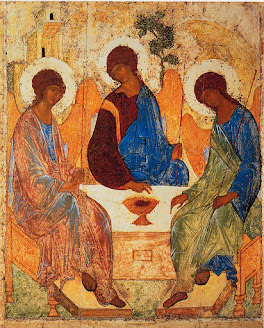
There is possibly no better cipher or symbol for this than the traditional Christian ‘Holy Trinity’.  God is three and one, said to be truly one and also truly not only one.  If we are personally able to use this frame of reference, immediately we are faced with the real inability of even our most basic concepts — “one” and “many” — to be applied in an exhaustive or limiting way to that which we call God.  Moreover, we are not only faced by this reality: if this is our language, we face this reality without withdrawing from being able to speak about God at all.  We embrace being able to say something, while also embracing that there is always so much more than what we have said. 

But there’s more: in the Holy Trinity we also encounter God as relatedness (for more on this, explore the writings of Gregory of Nyssa), in which the titles ‘Father’, ‘Son’, and ‘Holy Spirit’ all refer back to each other, and are understood in view of each other.  This framework suggests that the ways of relating to God are many, not because they can be but because they have to be.  Each and every one does not stand alone but implies the others too.


This is not the place to develop a theology of the Holy Trinity, though there is a rich and beautiful tradition to draw on, which many Unitarians have neglected, that delivers a treasure trove of insights about relating to God, in the light of God’s self-relatedness.   Similarly, in the Hindu tradition, inherent to the universe is the relationship of Brahman the unmanifest potential of all that can be, sometimes known in the west as the Godhead, and Atman the manifest, the created, the ensouled God.  And in respect of this all-pervading relatedness, there is a wonderful Hindu saying: 

'You think that you understand TWO because you understand ONE, and ONE AND ONE MAKE TWO; but first you have to understand AND.'


For now I just want to make the point that in the same way ‘God’ as a no-name holds the place for that experience of the insistence on more , ‘Trinity’ holds the mind back from reductionist descriptions of the Divine and from mistaking any of God’s names as being exhaustive. 

The Apostolic Creed is in many ways an expansion of the idea of the Holy Trinity, not just in form (though there it is most clear), but also in reflecting on the meanings of each of the names of God given in that formulation.


How often do we get caught up in having to outline what we mean, and what we don’t mean, when we talk about or to God, in community?  We reach around, looking for shared experiences to draw on, and often find that for every good feeling invoked by a name there are profoundly negative experiences linked to it too.  We can find ourselves trying to use novel names or lengthy work-arounds which provoke responses we don’t intend — or which simply leave people cold.  Understood correctly, the moniker of Holy Trinity gets in there right from the start with the provisos, and moves our communitarian speaking of and to the Divine out of the realm of our many and varied personal associations with names; moves our speaking of and to the Divine into a place of a shared understanding of titles, and how they relate to each other and not just to us personally.

For some people, the experiences of their life may mean they never experience God in their lives as the ‘Abba, my Father’ of Jesus praying alone, but that doesn’t prevent them from honestly reciting the words ‘Our Father’ with the community.  Nor does it mean that they can’t experience the private intimacy in prayer that the words ‘Abba, my Father’ reveals. 


We fear that the way we talk to and of God in our communities will exclude and marginalise.  That concern is born of love, and of the awareness of how differently people can experience the world. Yet the truth that no name, taken alone, exhausts the Divine — and that how we learn in community to talk of and to God is the starting point not the end of our own lived relationship — can set us free from the knots we tie ourselves in.  To say ‘God is Father’ is to say something but not everything; it is to affirm something but not to exclude everything else; it is to indicate something but also to draw attention to there being more.  The Holy Trinity helps us keep our minds as open as we want our hearts to be, so that we can share in community not by ignoring diversity of experience but by embracing a shared context and a profound respect for God in the lives of each and every one of us. I believe in the Holy Trinity.


16 June 2020

In the beginning was the experience of Truth — How to say “We believe….” as recognition of community


We Believe
Often we read or hear something and our first thought is “I wouldn’t say that” or “I’m not comfortable with that language”.  We pore over the words of hymns or dissect the latest sermon or blog, and all the while we draw lines and dig trenches.  Creedal Tests have been used for centuries to do the same — as if Truth were a sword to separate the Sheep from the Goats, or the wheat from the chaff. 
Pause. 
Breathe. 
Don’t ask yourself if you agree with me; just take a moment to see if you can hear what I’m saying.  No one requires you to do anything or take any stance for the moment; and when that time comes you can, and you will.  But this isn’t that time, not yet.
I believe Truth isn’t a sword: it’s that in which “we live and move and have our being” (Act 17:28, Cretica by Epimenides).  It’s not something to use to divide and hold apart; rather, it is the very thing that makes us one.  It isn’t something to use to conquer others; it is the very foundation that allows us to be free. 

EPIMENIDES OF CNOSSOS a semi-mythical 7th or 6th century BC
 
Greek seer and philosopher-poet.

When I say “I believe”, I am not telling you what you ought to think, or requiring you to confirm my view.  I am sharing with you something about how I experience the world, offering a glimpse into why I say and do the things I do.  I am speaking my Truth.  That is to say, I am voicing that Truth open to all, shared by all, lived in by all but as experienced by me in all my limitations, with all my back-story, and in the language I have learned throughout my life.  
Expanding that idea, it is a beautiful thing to be able to say: “We believe…”.  It is an acknowledgement of a shared experience, a shared language, and shared hopes.  It is never the fruit of a simple debate over concepts and words: it is, at heart, a recognition of community rather than a tool for forging it.  The words of a Creed can inspire the conversation, the prayer, and the actions that bring about the “We believe …” moment, but they themselves neither create it nor constitute it. 
The Apostolic Creed, one of the most widely used and oldest of the creedal statements in Christianity, has to be understood in the context of a shared community, a shared set of stories and rituals, a shared experience of life.  It was spoken believer to believer, and is deeply embedded in the ritual of Baptism — where the dialogue isn’t one of Gatekeeper to Supplicant but, rather, the excited back and forth between friends or new partners.  The “Do you..” and “I do ..” is not one of uncertainty but of already knowing the answer and delighting in hearing it out loud.  Think of the wedding ceremony where each partner is asked if they take the other: there is no uncertainty at this point, and yet the saying of it out loud is still so much more than formality: it is a joyful expression of their relationship to each other and the community around them. 


The excitement of retrieving the football - which will
 become a shared story, a shared experience of life

The Apostolic Creed is not the Creedal Test that has rightfully been recognised in terms of power dynamics and control.  It is not accompanied by the cudgel of “say this, think that, or else”.  It is the joyful celebration of a shared experience of the divine, in a community of shared stories, shared rituals, shared prayer, and shared hopes.  This Creed is a shape not arrived at by carving into, or by cutting away, according to a precise, planned view of the end result, but rather a shape grown organically according to the nature of the living material and the conditions over time it finds itself in.  It is a shape that shows its history in every twist and knot, but is always growing, never knowing what the future will bring for it — yet unafraid because growth is not deviation from a plan, it is not failure, it is the success of ongoing life and vitality.


knotted, gnarled, organic growth - this is an apple tree
 but it may as well be a creed from the 4th century CE

“We believe …” can be beautiful, it can be joyful, and I think — if we are honest with ourselves — it is something we all long for.  Though we may all fall into the pride of wanting to push our views and our expressions on others, and though we have all seen too clearly how easily Creedal Tests have been used to exert influence and put pressure on individuals and groups, our longing is not for the set of words.  The shared experience of the Divine, the communal life of shared stories and prayer, the excited back and forth of connecting with others at the profoundest level: that is what we thirst for.

We long to be one, not by giving up our personhood, not by rejecting the quality of individuality, not by capitulating to the will of others, but by embracing the community, by shared living in Truth.  I haven’t lost hope for that “We believe…” moment, that Creed ‘in spirit and in truth’ (John 4:23) and I believe the surest start towards it is acknowledging the culture and the stories that have shaped me and which I already share with others.  Despite the name that the tale is more commonly known by, there were two sons in the tale of the Forgiving Father (Luke 15: 11-32): together we can write an ending where no one is left sat outside.

04 November 2019

Being a disciple of Yeshua, a teacher of 'oneness'


The thing about Unitarians is that we seldom stand completely in one camp.  Just as we rarely hold a vision in common about how the multiverse operates, we rarely confine ourselves to one community of faith.  Seeking guidance, help and inspiration from a wide range of human sources (experiential, emotional, artistic, historic, scientific, mystic; solo and collaborative) - and from environmental sources as we live as animals on this Earth - we also tend to wander freely between circles of influence in terms of faith teaching.

So it is a rare Unitarian who adopts a single, or even prime, teacher to guide their path.  A number of UK Unitarians are satisfied in labelling themselves Unitarian Christians, and in doing so are content to be seen as people for whom the Jewish rabbi Jesus (or Yeshua) is the prime reference.  But the practice and contemplation of Unitarian Christians is not exclusive to Yeshua - there is a wealth of guidance available under the generic “Christian” banner that has not directly come from the words or actions of Yeshua, but instead, has come in an indirect way, from the thoughts and actions of other followers of Yeshua who have gone before.

For myself, for instance, I have gained a lot from paying attention to the guidance of the Abbot Benedict, a Roman Catholic monk living in the sixth century, and the Rule for life in community which he crystallised for his monks; as well as from various contemporary commentators on Benedict.  But that feels a long way removed from the words I hear reported as coming directly from Yeshua, as written in the Bible.  I have learned from Christianity rather than directly from Yeshua; and so I do not really think of myself as a Unitarian Christian.

Now, because of my interest in Benedict, I belong to a Benedictine group, whose members alongside me are traditional Christians.  One of the books we are currently reading together is a book by Professor Rowan Williams, Being Disciples.  Unlike the rest of the group, in the reading of this book there is work for me to do, to translate terms, directed by the author at traditional Christians, into terms that seem to me to be universally applicable.  It is only by doing this that I can hold true to my Unitarian calling: I strongly feel that a teacher has been truly wise only if their teaching can be applied to all humankind, not to just a select grouping, or to a specific time.  ‘What is true everywhere, over all time’, worded also as ‘oneness of all humankind’, is crucial to me.

So I am now reading Williams’ Being Disciples with this question, this context in my mind:  Yeshua the teacher of ‘oneness’.  Because, if ‘oneness’ is the touchstone for a Unitarian, then a teacher will be helpful to the extent that they address the ‘oneness’ issue.

Williams suggests that being a disciple - a student of a teacher or guru - is not a set of ‘I can pick up-I can put down’ activities, but rather is a state of being; and that it requires staying in the company of the guru or teacher over long periods, even when nothing much seems to be happening.  It requires being attentive to the teacher, he says, and going with them even as they go to places you would not have chosen for yourself.  That bit is very important.

In Williams’ book we are reminded that Yeshua went to some places his contemporary followers found very uncomfortable; and that he received criticism for both his behaviour and for the company he kept.  From the ‘oneness’ standpoint, I see Yeshua deliberately taking action to challenge and break down the traditional divisions between people.  He taught, as well as showing by demonstration, that those granted power and authority over others should behave humbly and put the needs of others before their own needs: the famous foot washing (John, Chapter 13).  He broke taboos by eating and associating with people who were regarded as the dregs of Jewish society; and with despised collaborators with the Romans (e.g. tax collectors).  It is clear that Yeshua saw such exclusions as running counter to what is best in and best for humankind, and he demanded that those who followed him should set aside such barriers.  He emphasised an old teaching of non-exclusion in Judaism: that the very ingredient left on the side is the key element in the whole affair. (Psalm 118, quoted by Yeshua in Matthew, Chapter 21; Mark, Chapter 12; Luke, Chapter 20).

Yet - demonstrating to me his humanity - Yeshua was not himself perfectly consistent in living his message (and knew it: “Why do you call me good?  Only one is good, and that is God.” (Matthew, Chapter 19; Mark, Chapter 10; Luke, Chapter 18)).  He was challenged to reach out beyond his Jewish cultural habits: to a Roman soldier who sought healing for a member of his household (Matthew, Chapter 8), and to a Samarian woman at a well, whom at first Yeshua seemed reluctant to include (Matthew, Chapter 15).  Yeshua was stretched on both these occasions, but he passed the test of his own message - when the chips were down - by treating these others as he treated his own.


So Yeshua was looking for ‘oneness’ between all sorts of people.  And if we choose to use his teachings and example as our guide, we must work to break down barriers between people, and treat the last as first, even at the cost of placing ourselves in situations not designed for our own comfort.

~~~~~

But Yeshua’s teaching is not limited to ‘oneness’ of human society.  As a mystic, his teaching extends to relationships with God.

Prof Williams suggests that: “…The relationship of Jesus to the Father is not episodic.  Jesus does not receive an occasional bit of instruction from the Father; his relationship is sustained, eternal and unbroken.”

My own reading is that Yeshua is attentive to the divine reality in a continual way; an unending ‘oneness’ subsisting between him and what brought him into being and sustained him.  And then he extends that: he extends the ‘oneness’ between God and himself, to a ‘oneness’ starting with God and including himself then extending to his disciples: “I am the vine and you are the branches.” (John, Chapter 15).  “My Father, who gave them to me, is greater than all; and no one is able to pluck them out of my Father's hand.  I and my Father are one.” (John Chapter 10).  “Truly, I say to you, he that receives whomsoever I send receives me; and he that receives me receives him that sent me.(John Chapter 13). “No man knows who the Son is, but the Father; and who the Father is, but the Son, and he to whom the Son will reveal him.(Luke, Chapter 10).

It seems that Yeshua sees this experience of ‘oneness’ with truth and reality as both possible and essential, for anyone who wishes to follow the same path: “The Kingdom lies within you.” (Luke, Chapter 17). “Rejoice because your names are written in heaven.” (Luke, Chapter 10). 

And Yeshua uses the idea of God as Father, rather than Judge, to indicate the familial intimacy and connectedness that we should feel with God.  So Yeshua, the breaker of barriers between people, is encouraging his followers to see a continuum, not a separation, between their worldly being and the creative power, or will, that brings them into being.

And perhaps the most famous of all the teachings of Yeshua is this: “Thou shalt love the Lord thy God with all thy heart, and with all thy soul, and with all thy mind.  This is the first and great commandment.  And the second is like unto it: thou shalt love thy neighbour as thyself.  On these two commandments hang all the law and the prophets.”  (Deuteronomy, Chapter 6 and Leviticus Chapter 19, quoted together by Yeshua in Matthew, Chapter 22; Mark, Chapter 12; Luke, Chapter 10).

As Williams has it: “…so we in our discipleship [of Jesus] are summoned to gaze into the mystery of that infinite love and to seek to do that same eternal will: to ‘act’ that same action, on earth as it is in heaven, as the Lord’s Prayer puts it.”

~~~~~

So it seems to me that Yeshua is - among other things - a teacher of ‘oneness’: a ‘oneness’ stretching from the source of the multiverse, through the laws governing evolutionary environmental existence and human society (“heaven and earth”), through the compassion wisdom of the spiritual guides and the prosaic nature of ordinary life, to concrete expression in the most outcast, ignored and helpless of our kind and of animal kind.  Yeshua’s teaching infers a demand for an attentive recognition of the integrated web of relationship and interdependence, and this as part of an unending search for what is best in and best for humankind.

And again from Prof Williams, regarding what the actions and teachings of Yeshua can be used towards as we live today: “…what it’s all finally about is enabling you to do some very ordinary things a little bit better, in a way that is suffused by eternal love taking up residence in the heart…..what the disciple learns: how to be a place in the world where the act of God can come alive.”


07 July 2018

Unmaking the World - a conversation about how we respond to the ecological crisis #unitarians #inclusiveunitarians

We did not know, when we booked the evening for a talk on environmental ethics, that the England football team would be playing Colombia for a place in the World Cup quarter-finals on that same evening.  Fortunately, owing to the big screen in the pub garden across the alley, the people who had come to the talk were able to - more or less - keep track of the match as well as the talk!

So not surprisingly we were a small group of people meeting together to hear Dr Claire Foster-Gilbert, but that had the advantage that we were able to have a proper conversation rather than a formal lecture and Q&A session afterwards.

Claire started with the 20th century philosopher, Heidegger, who had identified that the mindset that views everything in our surroundings to be ‘stuff we can take and use’, is probably one of the root causes of the ecological difficulties we find ourselves in today.  Claire reminded us that humans had probably always had that mindset, which had of course led to much good, when viewed from our human standpoint; not least in medicine and dentistry and extension of human life.  Our difficulty is not that we have changed, but rather that we have become so numerous.  Whereas we could get away with treating the Earth as a treasure storehouse when there were fewer of us, we cannot behave like that any more.  The Earth is showing signs now of the change that we have caused, and humans are now suffering along with it.  We need to find a new way of seeing, because when we see differently we will think differently and act differently.

In particular, Claire contends, we have lost connection.  We view ourselves as tenants, stewards or even masters of the Earth, rather than small but integral elements within the entire eco-system.  We fail to recognise that the reason we feel so much better when we go out of doors and do what we call reconnecting with nature, is that we have evolved in it, as part of it, suffused by the dynamic interrelationships that is the only realistic way of defining ecology.  Of course being out there makes us feel better: out there we shed our skewed perception that puts us at the centre of a set of ‘things’ we imagine we can control.

As we have lost connection, we march along the road of technological progress making judgments that, with hindsight, do little but penalise the ecosystem - and hence ourselves along with it.  Only when we have changed our way of seeing will we be able to act in concert with our environment, and thus protect our dwelling place in the long term.

To help us see a practical way of changing the way we see, Claire led a guided meditation through the five spheres of the Earth: the atmosphere, the hydrosphere, the lithosphere, the pedosphere and the biosphere.  We were invited to take several images away with us, to bring to mind in our daily activities; images that will change our perspective on our activities on a domestic and intimate level.

We noted that while it is possible for us to act at a distance to help other humans who now suffer from ecological impacts, it may in the end be more effective to act locally in tune with the five spheres, then trust the five spheres to help our fellow humans at a distance.  After all, as one participant pointed out: when we think we need to feed our plants, we are wrong, and actually, we can’t, because that happens at a cellular level.  What we need to do is to feed and tend the soil, and the soil will feed the plants.


[The lithosphere and pedosphere
The lithosphere is the outer crust of the earth, some 120 km thick, rock floating on molten rock.  The pedosphere is the soil that lies on top of the lithosphere like skin on flesh, about half a metre thick, made of sand, clay, silt and organic matter.  It acts like a cleansing and protecting membrane between the lithosphere and the atmosphere. 

The biosphere
The biosphere is the sum of all the habitats in which species live. ]


Atmosphere:
When you next find yourself walking, feel the air on your face, become aware of your breathing, and realise the total and automatic dependence of the life of your body on the atmosphere.  Gain a sense of ‘being breathed’ rather than the other way around.  See how the air is one thing: wind, breath, invisibly supporting, moving and enlivening all things.

Become aware that this same atmosphere is warming up and that for some living things, human, animal and plant, the 21st century will see the final destruction of their habitats and their livelihoods.


Hydrosphere:
When you next do something involving water, such as drinking a glass of it, watering a plant, or taking a shower, become aware of the cycle of water through the universe.  Become aware of it travelling to where it is needed, for nourishment, growth or cleansing.  Think of the water of baptism, by which you affirm your responsibility to the whole community.  Think of water as embodying the possibility of rebirth, empowerment, and the hope of a renewed creation.  
In the rainfall, in rivers and oceans, in watersheds, in your drinking, your washing and your tears, water cleanses, nourishes and heals.
Polluted water transforms nourishment into poison.  Absence of water kills very quickly, but not quickly enough for the terrible suffering of thirsty people and land.  
Become aware that today, 2 billion people live without safe water supplies.


Lithosphere & Pedosphere:
When you are next in a garden, crumble some soil in your bare hands and smell its rich aromas.  Think of the life growing in the soil, the way the soil nurtures and sustains new life, holds the seeds and shelters the roots, becomes the foundation from which the plant grows.  If you are weeding, notice how the earth holds on to her own as you gently dislodge roots from the soil.  Notice how the actions of your hands affect the soil well or badly.  Become aware of the cycle of life and death, of how we kill what we do not know, carelessly, uncaringly; and how the mending of the world that is to be done is beyond our power to do.


Biosphere:
Bring to mind the glorious, unimaginably numerous diversity of all living things.  There are not even two blades of grass that are the same.  Think of this biological diversity as a web of interrelationship that sustains all life on the planet, including your own.  You are not a tenant of the earth, you do not exist on its surface or despite its terrain.  You evolved with every bit of it, and that shared history is deep within you.  That is why the natural world has the power to restore you.  


12 June 2018

#Unitarians in Ringwood consider what shalom might mean in the rush of living in the world

We do our best with the reports of our gatherings, but the personal emotion and engagement during our time together has to be experienced to be believed.

At our gathering on 10 June we felt again the benefits of having a clear, familiar structure to our service.  Introducing the theme, the president for the day freely admitted that the thoughts that she had had in advance, which she was going to deliver, seemed to her to be rather random and unconnected.  But she was confident that everyone present would connect with them, in their own way.  And then, because the ritual is familiar, and open to everyone equally, the random ramblings were framed within a coherent whole, and their randomness did not detract from the experience.

There were the usual openers of the chalice-lighting words and a meditation, followed by a hymn.  We may not produce a good quality sound but we do like to sing!

Next there was our connection ritual in which we silently pass between us a candle (a flame perhaps representing light or love or truth), oat cakes (perhaps for food or bread or earth or body), water (perhaps for spirit or life flow or healing), and a fourth element (perhaps for air or breath or essence or connection).  In the silence each person present has the freedom to determine (or pray) the meaning of the elements for themselves.

Then we had two readings.

The first was by the person known as St John of the Cross.  It was a poem reflecting obliquely on the rich relationship between the author and the primal source of being, hidden by darkness of night.

The second reading was some words by Rowan Williams, culminating with the sentence: “And this is where the desert monastics have an uncompromising message for us: a relationship with eternal truth and love simply doesn’t happen unless we mend our relations with Tom, Dick and Harriet.”


The president then spoke about the swirling thoughts featuring these two ideas - the intimate, one-to-one relationship between a person and the source; and the contrasting need to live and stay living with the people around us, in perhaps grubby and difficult circumstances, if we are to make any spiritual progress.

But the third, random idea that had also occurred was the  concept of shalom/salaam.  A couple of scholarly insights into the word shalom were offered (see boxes).  It was suggested that only a peace that included living with, and in amongst, other people was a useful idea.  Also, that constantly seeking change and change of company, as a solution to spiritual ills, would not in the end be satisfying.


We then continued with the last usual parts of our gathering: lighting candles of joys and concerns, in which we begin to know each other better.  We ended our gathering after another hymn and a prayer.


20 May 2018

#Unitarian gathering in Ringwood considers the beauty of a complex, interrelated world and what Togetherness does for us

In our gathering on 13 May, we explored ‘Togetherness’ through the first chapter of Genesis and the prologue to the gospel of John.  A world where everything is in relation to something else; everything understood, and interacted with, as part of a larger whole.


We wondered at the beauty, elegance and mystery that we are living in such a world, and are not outside observers of such a world.


Then we considered how to look beyond our own relatedness by 'following the gaze' of others whose different 'relatedness' gives different perspectives on that world. Together we can see more.

We could, apparently, as humanity, all stand on the Isle of Wight.  So we thought it might be relevant to show here some different perspectives on the Isle of Wight...... 


20 March 2018

The #Unitarian demand for personal responsibility in matters of spirit requires maturity - the Ringwood gathering in March 2018 looked at Letting Go


Familiar faces were gathered there together on 11th March when we met to focus on the topic of “When I was a Child” – Letting Go.


We are vulnerable when young, when inexperienced, and in many other circumstances when we are reliant on the guidance and words from others, rather than on what we have found for ourselves.


We each have a ragged journey towards maturity.  We progress slower in some aspects than in others, and it is common for us to go to our graves immature in some way or other, with friends posthumously describing us as having had an incurable blind spot (or two) that were part of our unique charm.

For the most part we aim to become adult across the broad sweep of human activity, and to keep growing up throughout our life, but we forget that some ideas or rules that we take for granted are those we inherited as a child.  Unexamined, these can cause problems instead.

It is particularly important that we mature in our spiritual life, which is to say in those values and beliefs that, though hidden, drive our deepest and most instinctive behaviour. 

Instructions meant to help us in our early years need to be let go when we have moved on from the help they can give.  The choice and challenge are our own.  We have to take responsibility for our own becoming, our own knowing, our own doing, and our own relating to the world.
If we don’t let leftover, irrelevant knowings diffuse away, or transform into something more appropriate, we are the authors of our own continued knottedness.  It’s not always easy to do, especially since – inevitably – those instructions were given to us when young by people whose authority we trusted, often within the family or placeholders for family.

The readings we heard were by the apostle Paul (1 Corinthians 13), William Shakespeare (Romeo & Juliet, Act 2 Scene 2) and Dennis Lee/Jim Henson/Terry Jones (Sarah’s closing speech from the film Labyrinth).  We also enjoyed learning some new chants, some trickier than others.


Through dangers untold and hardships unnumbered,
I have fought my way here
To the castle beyond the Goblin City,
To take back the child that you have stolen,
For my will is as strong as yours,
And my kingdom is as great.
You have no power over me.