Showing posts with label belief. Show all posts

06 December 2022

What does 'being Church' mean? How does that seem to #Unitarians? - Ringwood Unitarians' gathering 11 November 2022

Our gathering in November was nearly cancelled but we are glad that it went ahead despite a very low turn out.  Because this was a very important gathering, asking big and important questions about what Church means to us.  What does ‘being Church’ mean?  What does ‘Church in action’ look like?  Why do those of us who gather find it necessary to gather?  Why don’t we simply carry on with our spiritual journeys, each a pilgrim on their own?

The gathering was really an enquiry about what 'being Church' is, or could be, for Unitarians.


The memorial board for the fallen from the
previous Unitarian congregation at the Meeting House


It being Remembrance Sunday, the candle in the chalice was lit to words adapted from For the Fallen by Robert Laurence Binyon (1869-1943).  And then, as usual, we were invited to privately take stock of the recent days and weeks and to be honest about how we well we had been living up to what is most important to us.  Later on in the gathering, after the readings and reflection on them, we lit candles to share our joys and concerns, and heard words of hope and blessing.


Our blog habitually devotes more space to the readings we hear in a gathering, and the reflection on the readings, merely because words can easily be brought across into the blog.  It is not possible to bring across into a blog the experience we have when we use prayer words together, light candles together, sit in silence together, or the feeling of singing together.  You will only truly get the flavour and feel of our gatherings by coming along to one.  So please do, when you are able.


We heard two stories made famous through the teachings of Jesus, namely “The Good Samaritan” from the book of Luke in the Christian Bible (Chapter 10 verses 30-35), and “The Prodigal Son” also from the book of Luke (chapter 15 verses 11-32).


For those unfamiliar, “The Good Samaritan” is a story in which a traveller gets mugged on the road from Jericho to Jerusalem, is ignored in his danger by upstanding members of society, yet is made safe and helped to get better by someone whom Jesus’ audience would have considered outcast.  And the story of “The Prodigal Son” tells of a younger son in a family, who is granted his share of the inheritance, then leaves to go abroad and wastes it all, and eventually goes back where he came from, with his tail between his legs.  Whilst his father makes him welcome, his elder brother is very grudging and resentful. The father attempts a reconciliation between them.


Before going any further, it is necessary to make clear there are (at least) two different inferences in the word ‘Unitarian’.  To be a Unitarian can, as well as other things, mean that (1) you experience or claim or guess that the divine nature is necessarily a “one-ness”, as contrasted with the “multiplicity” of the Hindus and Pagans, or “three-ness/Trinity” as traditional Christians maintain and/or (2) no matter what you experience or claim or guess about the divine nature, you have some form of allegiance to or participation in the movement that calls itself the Unitarian Church in the UK.  The first is a statement about belief.  The second is about involvement in a group or body of people.


(library image)


Like many other religious affiliations, labels about us are messy.  People need wriggle room.  Things are not clear, even privately to each one of us, and less so when in community.


What follows are the reflections on the readings, from the person presiding on the day.


~~~~~~~~~~


Unitarians in the UK have a mixed lineage. The congregations we know today have varied histories and were born out of differing Christian traditions.  While it is not hard to find Unitarian people throughout recorded history, and indeed one could argue right back into the Bible, the actual Unitarian congregations we have today are reconfigured from reformed churches (for more explanation of reformed churches, see Wikipedia https://en.wikipedia.org/wiki/Calvinism). 

To some now (and, I am sure, it has always been the case), what matters is the personal journey, the search for truth and the striving to live accordingly.  It is no surprise, then, that in both our readings the journey features strongly.  The road from Jericho to Jerusalem on which the journeyman was waylaid.  The road back from foreign lands to the father’s house.  The spiritual path is one that none can tread for us and one that is rarely strewn with palm leaves. 

But while each of us has a private, personal spiritual path or journey, we in Ringwood suggest that what distinguishes a Unitarian from a solitary pilgrim is someone valuing the experience of Church, of gathering, of being part of something; part of a bigger journey that gives a context for our own journey too.  

Without a coming together there would be no congregations, Unitarian or otherwise.  And that would mean there would be no place for those on their personal journeys to rest or find impetus to go further or change direction.  We who gather, often or occasionally, clearly see something of value in our congregations and in our wider movement.


In our first reading we encounter the journeyman in a bad way.  The road has been unkind; and far from making their way onwards autonomously they are in pain and in need.  We will all be in that position at some point, now and again.  Perhaps we will have seen things we cannot accept, or will have done things we cannot undo.  Perhaps we will have led astray people whom we care about; or perhaps we will have been oppressed by questions we cannot approach.  Life is tough, and our journeys through it have their dark places and blind corners, just like that road from Jericho. 

I don’t think it is by chance that the first two people who come along are church people; first, the equivalent of the Minister or Preacher, and second, the Music Organiser or Pulpit Rota Lead. These are good people, people needed in the making and sustaining of a congregation but, in this tale, they are busy on their own personal journeys.  They are visible and essential parts of a congregation, but in this story they do not demonstrate the characteristics of Church.  The story tells us they passed by on the other side.  And so we can see: we can have roles in a congregation, but yet be isolated individuals on private journeys, without being Church. The first reading, and my own heart, suggest this is not enough.


The third person comes along, and you need to picture this person as someone in your congregation who outwardly values very different things in congregation from what you value.  If you like silence, they’ll be the one who wants to discuss everything.  If you like energetic interactive gatherings, they’ll be the one who wants to stick to a sermon and song.  Whichever hymn book you like, they’ll love the other one.  You often find yourself wondering why you and they are in the same congregation at all.

This is also the person who doesn’t pass by on the other side. 

This is the person who puts you onto their own horse or donkey, the person who is aligned with you enough, who cares enough, to share with you what has helped them along the way. 

This is the person who takes the time to pay attention to your hurt and to do what they can to help you heal.

And this is the person, whose support of the wider congregation firstly allows you the space and time you need to heal, and which secondly allows you both to continue on your personal journeys at your own pace and in your own ways.

Our first reading doesn’t denigrate the vital structural roles and responsibilities in our congregations, but it does suggest to us what Church looks like in action.


In the second reading I see a suggestion for why we come together, not just what coming together could look like. 

I was wary of this second reading.  For myself, it is one that comes with weighty layers of imposed meaning, and that might be the same for some others too.  Bear with me.

I remember discussing this reading with some young monks many years ago.  One of them heatedly, and bravely, confessed that he understood the grudging resentment of the elder brother.  That he, too, sometimes felt frustration and injustice that others could come along and enjoy all the good bits of congregational life, whilst not putting in all the hard work and sacrifice that he had. 

It would be easy here to look, once again, at those with clear roles in a congregation  — or even those who just turned up gathering after gathering — and say that doing those things alone isn’t enough to make a Church.  There is no congregation without these people and, like for that young monk, the frustration of the elder son is always a risk on their personal journeys.  But that is not what I take from this second reading.

It is not what divides the older and the younger son that interests me.  It is the words of the father who would bring them together:

‘Son, you are always with me, and all that is mine is yours.  But we had to celebrate and rejoice, because this brother of yours was dead and has come to life; he was lost and has been found.’

What can unite us, what has the prospect of bringing us together, is celebration; celebration of rising again every time we fall; celebration of finding a new way every time we hit a dead end. 

We come together to celebrate our personal journeys, united in hope for our way ahead.


I value the personal journey.

I value the camaraderie of the road.

I value those who give their time, their labour, and their resources to provide a place to rest and heal.

And I value the celebration of all of that.  I value the gathering together to sing into the darkness, to set lights ablaze and tell our tales of hope that we might make them true.

Is this what Church is for Unitarians?  I do not know for certain, but I hope there is something in this that you can value too.

A mixed group of Unitarians, some years ago.


22 June 2022

The clock is ticking - everything counts but nothing matters

https://www.eurekalert.org/news-releases/645392


It has been known for some time that the end for Earth will come when the sun flares up prior to its final collapse.  All will end.  And yet, despite that knowledge, we have seen worth in living generous, virtuous lives along our way - or the way of humankind - towards this final collapse.

It's not that we haven't believed that the world will end in the way Professor Brian Cox and others on the mainstream media have clearly explained to us.  It's that we nonetheless think we can live while we walk towards dying, rather than just sit in the gutter bewailing the final fate of the globe and everything on it.

Faith systems enjoin us to recognise we have an end coming, yet we can and should - for our own well-being during our brief stay here - strive to live good lives: bringing into our connected thinking everyone and all creatures; governing justly; and relieving all forms of poverty.

I admit that, until some years back, I thought I would not see the end of the great human experience and experiment in my lifetime.  I was embarked on the path of 'striving to live in good faith' while here but seeing it as being far over the horizon.  Millions of years away.

Well: I now see a strong likelihood that human life as I know it will disappear only shortly after what I had been content to consider my natural span (which may turn out to be shorter than I had thought).  But does that change anything?

Does it change my thinking, my believing, my behaviour?  Why should it?  Nothing has actually changed, except the timespan.

The clock is ticking.  Everything we do now counts.  

Ultimately, nothing matters.  The Earth is destined for utter destruction.  But let us be the best us we can be, doing the best we can for other creatures and for ourselves, for as long as we can.  Because that would be a good thing to do.


15 May 2022

Who do you think you are? Who do you say I am? Two questions whose answers are always shifting - Unitarians in Ringwood gather again in May 2022

It’s such a different experience — being there, compared with being told about what it was like to be there.


Reading a blogpost about our gatherings, whether online or in person, is always likely to leave the impression that our gatherings are like lectures, webinars, study classes.  They are never like that.  In the subtlest ways, everyone in the room participates and changes what transpires, changing it into a woven, group activity.  And as our gatherings take place explicitly to allow a space for reverence to emerge, whether that reverence is in regard to a special circumstance of life, a personal deity, or, as most would probably suggest, the biggest mystery of all (life, in its fullest), the woven, group activity evokes what cannot be conveyed in a written report.


Our gathering on Zoom on 8 May 2022 included singing along to videos, silence for personal reflection, two readings from the Christian Bible, and a period for sharing joys and concerns in our minds at the time.  On Zoom, other rituals are more difficult to arrange, and we will be considering that as we move back to meeting in person, in July.  We have no intention of meeting in person merely to listen to someone’s words about somebody else’s written words that have been read out loud.  There has to be more to the act of gathering, than that.


A view from above of a group of adults sitting in the pews at the front of a Georgian church, which is the Ringwood Meeting House.
This is representative - it's a gathering of Unitarians in the
 Ringwood Meeting House, but this is an old picture.


Nonetheless, you’re reading this because you want to know what theme was covered in our gathering, so here goes, as usual.


We opened with a recollection that, though it has to some extent worn off to people in the UK, in Ukraine there is no escaping the continuing shock of the invasion.  We lit our chalice candle while hearing words prompting us to keep watch with those suffering: 

'My soul is sorrowful, even unto death: stay awake and keep watch with me.' (Book of Mark, chapter 14 verse 34)


The first reading was from the Bible, book of Job, chapter 38, verses 4-21.  God confronts Job, saying, 


‘Where were you when I laid the foundation of the earth?
    Tell me, if you have understanding.’


We heard a second reading from the Bible, book of Mark, chapter 8 verses 27-30.  In this reading, the teacher Jesus is asking his followers who people think he is.  And Peter answered Jesus, ‘You are the Messiah.’


The president of the day reflected on the two readings.


“In our first reading we are given the fictional speech where God turns the tables on Job and all his wise friends.  Job has been asking the hard questions, and his various friends have trotted out the ‘right answers’; but none of it has been satisfying.  Finally, it is God who speaks.


“God unfurls the wonder of the cosmos and the passing of aeons, and in essence poses the question, ‘Just who do you think you are?!’  The wonder is not that Job does not know all the answers, or that he is left with so many questions.  The wonder is that anyone should ever have thought they knew it all !


“Whilst there is a nobility and vitality in wanting to know more and to understand better, it is foolishness and arrogance to think that any of us has ever got it all worked out.  That is not to say our insights, our thoughts, and our experiences are worthless.  It is not to say that there is no difference in value between one way of seeing and doing, and another.   But it is to say that there is always more to know, more to ask, more to do. 


“This confrontation, staged between God and Job and all the wise friends, is a call not to lose heart in the face of questions and doubts, and not to become rigid in our ideas, in our ways of doing and saying.  After all: who do we think we are?


“In our second reading we find a similar question posed.  The main protagonist of the Gospel of Mark is asking his friends and followers who the crowds think he is. They have a mix of answers: maybe John, the fiery preacher who was apparently recently executed.  Maybe Elijah, the returned ancient figure of power from the past. Or maybe, just one of the many insightful people who have something important to say.  There’s conspiracy theories in there, there’s fanaticism, and there’s perhaps more balanced respect and interest, too. 


“Then Jesus asks them who they themselves think he is. You can almost imagine an awkward pause. Would we have a ready made answer to this, if asked by someone important to us? 


“It is Peter who finally breaks the silence, by saying, “You are the Anointed One.” And that’s all the author of Mark has Peter say.  We’re not told what that means, or what that implies. We get that it marks Jesus out as special, but in what way?  Early readers of Mark would have immediately known that priests are anointed, prophets are anointed, kings are anointed, and, of course, the dead are anointed for burial too.  Mark doesn’t have Peter explain himself in his Gospel, and Mark doesn’t give us a narrator’s answer either.  The Jesus we read about in the book of Mark is said to be many things by the different people who meet him.  And, depending on their varying encounters with him, what they say of him and their actions towards him vary too. 


“Mark places Jesus into situations that were recognizable then and, with a bit of imagination, are recognizable now; but then has the man doing and saying the unexpected.  Mark is setting out a protagonist who is challenging to those around him as well as to us the readers: Jesus won’t let things be just as they are.


“If those crowding around Jesus want things to carry on unchanged, as they expected them to go, well then Jesus needs to go.  If, on the other hand, those following him want to keep hold of this figure who intrigues and inspires them, then it is other things that need to change or be jettisoned. 


“We know how this went.  Every character in Mark had to decide for themselves about this Jesus, and every reader of Mark has to as well.


“In a lot of ways, the book of Mark is a Unitarian Gospel. It challenges, and it asks the question, but it is left open to us to rise to it and to answer.  I offer you these two questions today — not as a test and not because I have the answers, but because the questions themselves are at the heart of our shared Unitarian practice.


“Firstly, who do you think you are?!  And secondly, when you think about the story Mark weaves around his strange protagonist Jesus, and the odd things Jesus does and says, who do you say he is?"


We finished with this blessing, based on Repose in The Sun Dances – Prayers and Blessings from the Gaelic, collected and translated by Alexander Carmichael.


Thou of Wonders

Shield us with might

Oh thou of natures laws and all its stars

Compass us this night

Body and soul

Compass us aright

Between earth and sky

Tonight 

Between the allness of thy mystery

And the blindness of our sight

Compass us this night

And every night

Oh thou of Wonders 

Compass us aright.


https://www.youtube.com/watch?v=GnlMktJTHTA


15 April 2021

Another creed

 It is often passed off as the case that the Unitarians have no creed.

As we have often remarked here, that is not the case.  Every Unitarian has a creed (in fact, we would argue that every person has a creed - a philosophy or set of values that they live by, whether they recognise them in that way, or not).

We have recently published here, in serial form, a take on the Apostles' Creed by one of our members.

This has set another one of our members thinking, about their own personal creed. And they are now happy to publish it here.  It's a photograph of the front page of their daily office (service) book and journal, ready and waiting to be seen and reiterated every morning, as a measuring stick for the previous day and a goal for the day to come.


07 August 2020

God the Intimate - Abba, Father - rich and contemplative provisos

(This is the fourth in our continuing series examining the wording of the traditionally Christian "Apostles' Creed" in a fresh way.)

Abba, Father

[God’s title of “Abba, Father” is only found referenced in the Bible three separate times, in the passages of Romans 8:15, Mark 14:36, and Galatians 4:6, which are all in the New Testament. Only two speakers utter these words in these passages: Jesus and the apostle Paul.  The word Abba is an Aramaic word that means “Father.”  It was a common term that expressed affection and confidence and trust. Abba signifies the close, intimate relationship of a father and his child, as well as the childlike trust that a young child puts in his “daddy.”]


I am going to use the words name and title interchangeably here. Though, be ready; I really want to be talking about title, even if I slip back into ideas around name.

I want to flag that fact, right up front and central; because whilst I always mean title, a way of saying something about ‘things’, a way of expressing a relationship of ‘things within a structure’, it is more common for us to talk in terms of name.  I am not looking to veer off into specialist language or make this jarring to read, but for the sake of honesty I want to be clear that this is what I mean.  Titles are bestowed from the outside; whereas the name is not just of them but from them.

A name, in the true sense, is personal.  A name is how we address someone we know.  If we’re lucky, the name by which we address someone also happens to be the name they know themselves by.  But this isn’t universally the case.  Does your cat really think his name is “Spike”?  Isn’t he, in his own understanding, “Cunning and Stealthy Hunter of the Night”?  A name is not as simple as what someone is called by, alerted by, invited by; it is how they understand themselves and it is how they give themselves to others.  Often the name we receive at our beginnings in our community  — as if it were indeed a title — is one we grow to fill.  For most of us it may become synonymous with the name in which we give ourselves to others; it may become integral to how we see ourselves.  But equally we can adapt it, even change it.  We tell others what our name is, no matter it may not originally have been our choice, no matter who may have given it to us first.  More seriously than “Spike” the cat, and perhaps of more relevance: is the name you gave to your son at birth the name she knows herself by (and has she yet told you her true name)?


Whereas, titles are about relationships: in fact, relationships are inherent to titles.  A community can teach us titles, because titles, like other jargon, are learnt by use within those communities.  We can all use the titles of our community, they belong to all of us, but the name is something given to us each personally.  “Please call me ‘Fred’,” is reserved for particular people within the community. 

However, even the titles we learn in our communities can become names — but they can only become names through a living relationship.  Then the name, unlike the title, is something we cannot share with others because it is not the sound of the word or the shape of the writing that creates the relationship, it is that living relationship that transforms that title into a name.  As an example: we call God by the title ‘Father’ in the Lord’s Prayer but it is the ‘Our Father’ of praying as a community.  For it to become ‘My Father’ — well, that is not something that can be taught or even tested from the outside: that is a matter of the lived relationship and personal experience in prayer.

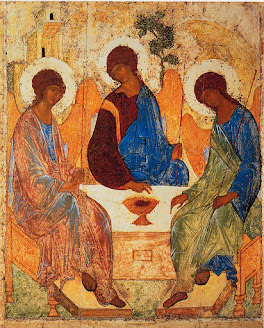
There is possibly no better cipher or symbol for this than the traditional Christian ‘Holy Trinity’.  God is three and one, said to be truly one and also truly not only one.  If we are personally able to use this frame of reference, immediately we are faced with the real inability of even our most basic concepts — “one” and “many” — to be applied in an exhaustive or limiting way to that which we call God.  Moreover, we are not only faced by this reality: if this is our language, we face this reality without withdrawing from being able to speak about God at all.  We embrace being able to say something, while also embracing that there is always so much more than what we have said. 

But there’s more: in the Holy Trinity we also encounter God as relatedness (for more on this, explore the writings of Gregory of Nyssa), in which the titles ‘Father’, ‘Son’, and ‘Holy Spirit’ all refer back to each other, and are understood in view of each other.  This framework suggests that the ways of relating to God are many, not because they can be but because they have to be.  Each and every one does not stand alone but implies the others too.


This is not the place to develop a theology of the Holy Trinity, though there is a rich and beautiful tradition to draw on, which many Unitarians have neglected, that delivers a treasure trove of insights about relating to God, in the light of God’s self-relatedness.   Similarly, in the Hindu tradition, inherent to the universe is the relationship of Brahman the unmanifest potential of all that can be, sometimes known in the west as the Godhead, and Atman the manifest, the created, the ensouled God.  And in respect of this all-pervading relatedness, there is a wonderful Hindu saying: 

'You think that you understand TWO because you understand ONE, and ONE AND ONE MAKE TWO; but first you have to understand AND.'


For now I just want to make the point that in the same way ‘God’ as a no-name holds the place for that experience of the insistence on more , ‘Trinity’ holds the mind back from reductionist descriptions of the Divine and from mistaking any of God’s names as being exhaustive. 

The Apostolic Creed is in many ways an expansion of the idea of the Holy Trinity, not just in form (though there it is most clear), but also in reflecting on the meanings of each of the names of God given in that formulation.


How often do we get caught up in having to outline what we mean, and what we don’t mean, when we talk about or to God, in community?  We reach around, looking for shared experiences to draw on, and often find that for every good feeling invoked by a name there are profoundly negative experiences linked to it too.  We can find ourselves trying to use novel names or lengthy work-arounds which provoke responses we don’t intend — or which simply leave people cold.  Understood correctly, the moniker of Holy Trinity gets in there right from the start with the provisos, and moves our communitarian speaking of and to the Divine out of the realm of our many and varied personal associations with names; moves our speaking of and to the Divine into a place of a shared understanding of titles, and how they relate to each other and not just to us personally.

For some people, the experiences of their life may mean they never experience God in their lives as the ‘Abba, my Father’ of Jesus praying alone, but that doesn’t prevent them from honestly reciting the words ‘Our Father’ with the community.  Nor does it mean that they can’t experience the private intimacy in prayer that the words ‘Abba, my Father’ reveals. 


We fear that the way we talk to and of God in our communities will exclude and marginalise.  That concern is born of love, and of the awareness of how differently people can experience the world. Yet the truth that no name, taken alone, exhausts the Divine — and that how we learn in community to talk of and to God is the starting point not the end of our own lived relationship — can set us free from the knots we tie ourselves in.  To say ‘God is Father’ is to say something but not everything; it is to affirm something but not to exclude everything else; it is to indicate something but also to draw attention to there being more.  The Holy Trinity helps us keep our minds as open as we want our hearts to be, so that we can share in community not by ignoring diversity of experience but by embracing a shared context and a profound respect for God in the lives of each and every one of us. I believe in the Holy Trinity.


28 June 2020

That word 'God'

In God

Do not be afraid.  

This is not the name used to coerce compliance to a set of rules, or used to open wallets for personal profit.  It is not the name behind which people doing bad things have hidden, or the name in which truly awful things have been done.  Some people have always tried to coerce compliance, to prey on the finances of others.  Some people have always sought to get away with doing bad things.  And history is full of people being truly awful.  There will always be people using anything that works to do these things; and we must not be blind to it no matter where or when it happens. ‘God’ didn’t make them do it, no matter how much our cultures and societies may have enabled it.  Those people need to answer for their crimes, and alongside that, other people need to recognise the abuses of systems and to change the systems.

God is not a name.

God is a no-name.

And I believe in God.

I believe in God the way I believe in Justice, in Truth, in Beauty, in Good.  When I say I believe in all these things I am not opening up a debate about their existence, as if I can point at them — or as if anyone would settle anything by pointing to a place where they were not.  I am not using the phrase to ward off responsibility for my words and actions, and I am not using it to give me an authority or power over others, though that can be done with any of those other things I believe in too.  When I say I believe in God I am sharing my experience of the world, and of something important to me about how I live in that world.  


When I say I believe in God I am witnessing to God’s insistence, not God’s existence (John Caputo, The Weakness of God).

Personally or in my community, I have never experienced God as a rare creature found only in particularly unusual habitats, of which tall tales are told and dubious sightings are shared in hushed tones.  My belief in God isn’t a scientific fact to be verified or falsified; it’s my witness to a lived experience of more.  The experience of an insistence that I try to be a better person, that I try to understand the world around me and my place in it better.  An insistence not limited to the will and wants of the people around me, not limited to my ease or preference, not limited to current success or bound by past failures.  An unlimited insistence that is neither without me nor within me (John Henry Newman, A Proof of God).  The experience of an insistence that there is something else just over the horizon, just behind that cloud, or around that bend.  The insistence that things go on, wherever I look.  This experience is subjective, in the sense I can’t ever separate myself from it; but it is objective in the sense that I do not choose it, it does not stem from me alone, and — more yet — it is at the core of everything I do or say. 


That which we call God is always more (Anselm of Canterbury, Monologion). Every time we alight on something and would call it God we are disappointed because it falls short (Plato, Phaedrus).  God is more: we experience God in the difference between how things are and how we feel they ought to be; between what we know and what we feel there is to know. 


God is more, which means for every title we give, for every description we use — however true, however just, however beautiful — there is always more, which it does not convey, than it conveys.  For every new insight that comparison reveals to us about God, it turns out that God is always more NOT like that, than God IS like that.  God is always more NOT as we imagine or intuit, than anything we fixate on God being. 


Not this.


Not this.


Not even this.

That very urge that makes you feel uncomfortable with the word ‘God’, that makes you want to shy away from using it, is your own witness to knowing that God is more than what ‘God’ is said to be.  I, too, do not assert an old man with a long beard on a cloud; I, too, do not assert an angry, joyless dictator.  I, too, can all too often see the human behind the curtain when ‘God the great and powerful’ is proclaimed, and am angry, and sad, at the abuse and the greed and the power-mad, wanton cruelty.  None of this will I call God.

God is the insistence that I cannot deny that these things are wrong, that we can do better, that things can be better, that there is always more.  God is not ‘this being the case because I want it to be’: God is more, and I believe in God.


13 May 2020

In the beginning was the doing and the doing became the Word - how to say "I believe" as part of conversation

“I believe…”
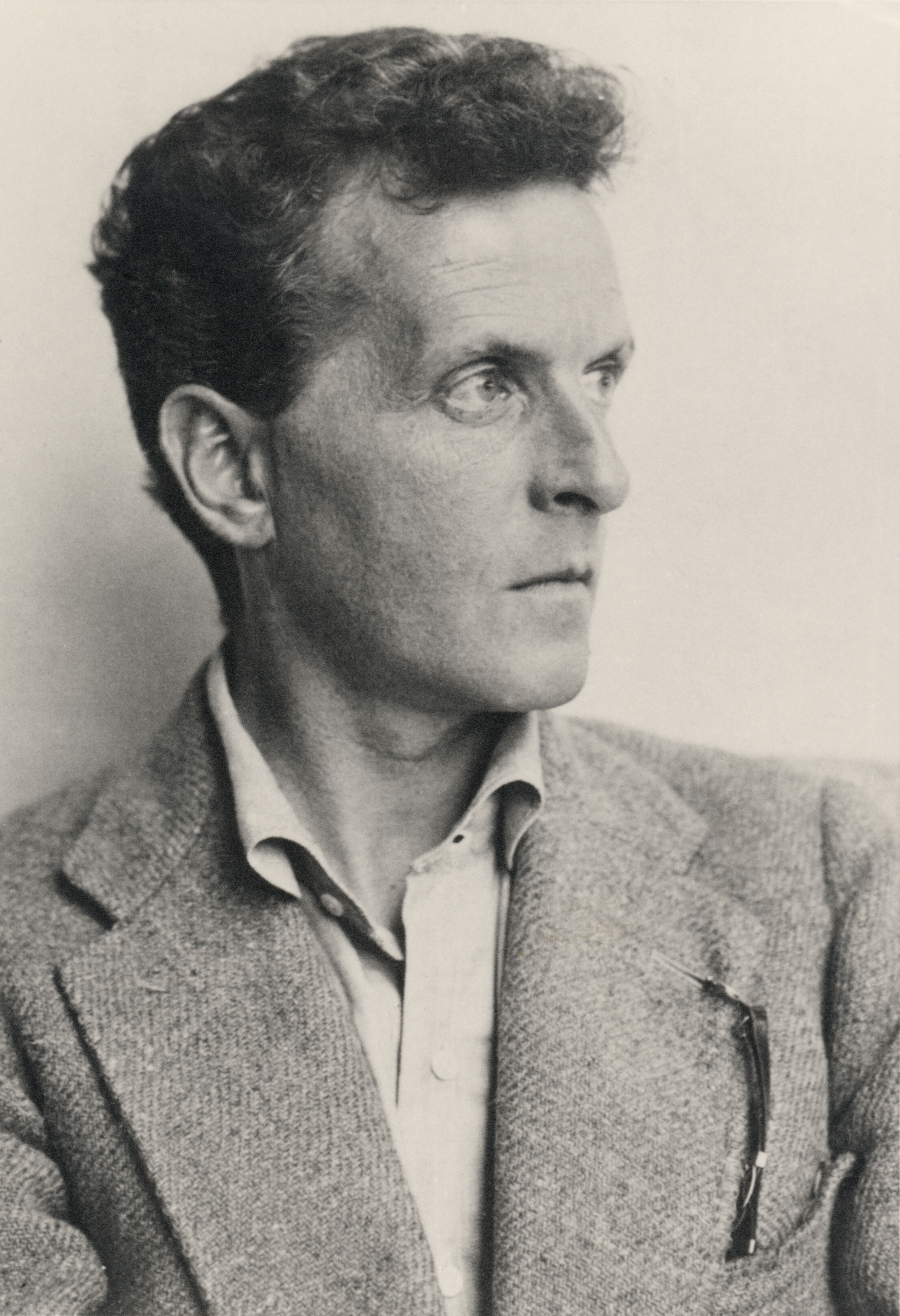
      I’m going to ask you to bear with me.  There are going to be times you want to jump in and point out things that are problematic, things you don’t agree with, things that need rounding off or balancing out.  Don’t do it.  I won’t take your silence for agreement and I ask you to not take any of mine for deliberate avoidance or ‘tacit denial’.  I’m going to advance a position today that suggests that what we say takes its meaning from the conversation we are having, and that that conversation is framed within the community, culture, and ‘way of life’ we find ourselves in.  This isn’t my idea, so I am not going to build it up from the foundations.  If you fancy checking it out in detail give Wittgenstein’s Philosophical Investigations a look. 
Ludwig Wittgenstein, 1930
The meaning I am looking for today is what we mean when we talk about our beliefs, how we understand what is said when we say “I believe…” or, I guess more often today, when we say “I don’t believe…”.
These kinds of statements, even when made in private, always have an audience, either actually there or imagined.  First off, we are saying them in a language that we have learned from others and use within a community.  
We don’t get to decide what a word means or how a language works, no matter how much we can push the boundaries of it. The more we nudge words outside their usual use the less likely our audience will understand what we mean, and the harder time we will have being sure we know what we mean ourselves.  Sound extreme?  Ask yourself how clear you are on something when you can’t share it with anyone else.  If you find yourself unable to describe it, explain it, or even show it, then you are going to have some doubts about it. 

      I spoke about nudging ‘words outside their usual use’.  We don’t learn language by understanding what one word means using a series of others.  We would never be able to begin, if that was how language worked.  We don’t learn language by clearly setting out and agreeing on terms up front; we need to already have language to be able to do that.  Rather, we learn language by doing things.  We learn to sit in chairs, to pass the sugar, to find the bathroom; and the more we do things with others the more our language grows, and the more complicated the things we do as a group, the more complicated our language becomes.  This starts right from our first words and carries on throughout our lives.  We’ve all started a new job and felt a bit lost till we were in on the buzzwords and shortenings; we’ve all taken up a hobby and at first felt bewildered by the array of new terms and phrases.  Those of us who have lived abroad and learnt a new language will recall how we moved from translating every foreign word back into a word from our mother tongue, and finally came to a place we could say and think and even feel things in the new language that we were unable to quite express in our first one. 

This fascinating book says a lot more
about how languages don't exactly match.
I’ve dwelt on this longer than I intended, but it is important because when we say “I believe...” we are saying it not just in our mother tongue, we are saying it in a certain ‘work’ or ‘hobby’ environment too.  We are saying it in the context of doing something together, simple or very complex: we are saying it in the context of doing something.  If what I am doing and what you are doing are not the same, if I am talking in terms of one environment and you in terms of another, then we may as well be talking two different languages.


      When we say “I believe…” we are conversing within a community and we are trying to do something specific within that conversation.  When we fail to acknowledge that community and to accept what is being aimed at we cut ourselves off from conversation and can only enter into conflict.  At the heart of that conflict is the need to impose on the other what we understand by the words they are using, and that need is driven by the deep desire to understand ourselves.  Socrates, in Plato’s dialogue Alcibiades I, speaks of how we see ourselves in the mirror that is the eyes of others.  Well: imposing what we want words to mean is rather like painting over that mirror with the portrait we’d like to see.  When we succeed in doing it, we harm the other and lose sight of ourselves as well.
"The Portrait of Dorian Gray" by Oscar Wilde
      If we are going to have fruitful conversations around what we believe — and even more so if we are going to build fruitful communities around what we believe — we need to learn to look into the eyes of others.  We need to realise that belief is something that isn’t about the sound of words or how we try to draw out the concepts; it’s about how we live.
In the Bible, ‘truth’ is something that is done not just said; knowing is about relationships, not just being right and being able to explain why.  I bring up the Bible here, not to rely on its authority, but because it relays thousands of years of human religious experience and because it is central to the community and culture in which many of us, myself most certainly, talk about our beliefs.  Whether we say “I believe …” or “I don’t believe …” we, here in the West, are talking in the shadow of that dominant narrative.  Our communities have splintered into smaller communities each with their own divergent stance to that narrative, but it is there for the Atheist Humanist, the Pagan Revivalist, and the Cultural Agnostic, as much as for the Roman Catholic, Protestant, or Non-Conformist.

       Acknowledging the role of language, and its reliance on communities and what we are trying to do at any given time, might sound like it is making saying “I believe...” difficult, like it’s making the conversation around that nigh-on impossible, but it isn’t.  All our language is rooted in the experiences we share, the things we can and can’t do, the world we live in as ourselves, the things we can’t change that set the stage for the things we can.  Language works, for all its nuance and contextuality, because language is how we live in a world we share.  We can say “I believe…” because of that shared world, that shared experience, that shared interplay of what we can and can’t change. 
If we put in the work to understand the conversation that is being had when we say “I believe …”, if we can hold back with pushing what we think ‘should’ be meant with the words, if we can actually engage with what is trying to be done in that moment, then we can begin to grow together and in looking into another’s eyes we can begin to see ourselves better too. 

      Belief is never purely intellectual: it is about how we live our lives, why we make our choices.  I hope we can explore that together, I hope we can share that together, and I know that if we do together, we’ll find that our language will bring us eventually more together, however much it may hold us apart for now.